


Best Free Zones in UAE for Startups
Introduction
Starting a business in the UAE? With more than 40 specialized Free Zones across the Emirates, choosing the right one can feel overwhelming.
Here’s the truth: there’s no single “best” Free Zone for all startups. The ideal choice depends on your business type, budget, visa needs, and growth plans. A tech startup needs different infrastructure than a trading company. A solo consultant has different requirements than a manufacturing business.
This guide cuts through the marketing noise to give you practical insights into the top Free Zones for startups in 2026, based on our experience helping hundreds of entrepreneurs establish businesses across the UAE.
What you’ll learn:
Table of Contents
- How to match your business to the right Free Zone
- Real costs and timelines (not just advertised rates)
- Which Free Zones actually support startups vs just saying they do
- Common mistakes that cost founders time and money
- When a Free Zone might NOT be your best option
Let’s start with the fundamentals.

Quick Answer: Top 5 Free Zones for Most Startups
If you need an immediate answer, here are the Free Zones we most frequently recommend for startups in 2026:
- DMCC – Best for trading, consulting, and service businesses seeking credibility
- Dubai Silicon Oasis (DSO) – Best for technology and software startups
- Meydan Free Zone – Best for budget-conscious digital businesses and freelancers
- IFZA – Best for flexibility across multiple business activities
- RAKEZ – Best for cost-effective manufacturing and industrial operations
However, the right choice depends entirely on your specific situation. Keep reading to understand why.
What Makes a Free Zone “Good” for Startups?
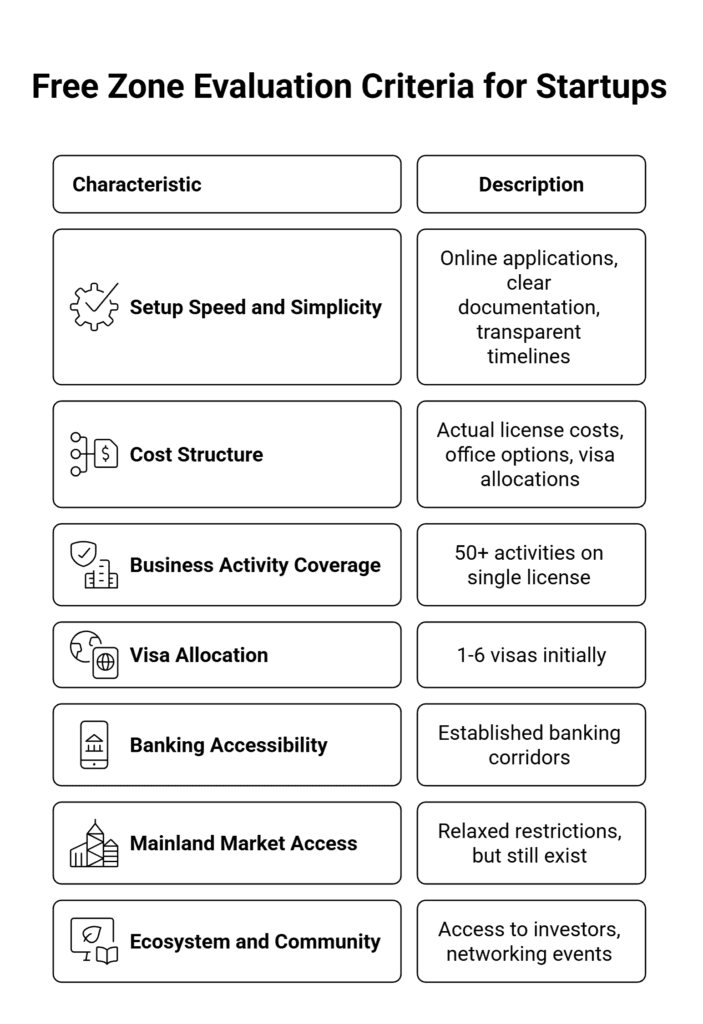
Before diving into specific Free Zones, let’s establish evaluation criteria. Based on feedback from our startup clients, these factors matter most:
1. Setup Speed and Simplicity
Startups need to move fast. The best Free Zones offer:
- Online application processes
- Clear documentation requirements
- Transparent approval timelines (2-5 business days average)
- Dedicated startup support teams
2. Cost Structure
Transparency matters here. Look beyond advertised “starting from” prices to understand:
- Actual license costs for YOUR business activity
- Office requirements and flexi-desk options
- Visa allocations included in base package
- Renewal costs (year 2 often differs from year 1)
- Hidden fees (municipality, chamber of commerce, etc.)
3. Business Activity Coverage
Some Free Zones allow 50+ activities on a single license. Others restrict you to 3-5. For startups that may pivot or expand services, flexibility matters.
4. Visa Allocation
Most startup founders need 2-6 visas initially. Free Zones vary dramatically:
- Minimum packages: 1-2 visas (suitable for solo founders or small teams)
- Standard packages: 3-6 visas
- Scalable options: Add visas as you grow
5. Banking Accessibility
This is where many startups hit unexpected roadblocks. Not all Free Zones have equal banking relationships. Some structures make UAE banks nervous (particularly offshore companies). The best Free Zones have established banking corridors.
6. Mainland Market Access
Free Zone companies traditionally couldn’t trade directly within the UAE without a local service agent (LSA) or mainland distributor. Recent regulations have relaxed this somewhat, but restrictions still exist depending on your Free Zone and business activity.
7. Ecosystem and Community
Do you need:
- Access to investors and accelerators?
- Networking events and founder communities?
- Modern co-working spaces and meeting rooms?
- Industry-specific infrastructure?
Some Free Zones excel here; others are purely administrative.
Understanding UAE Free Zone Structures

What is a Free Zone?
A Free Zone is a designated economic zone with its own regulatory authority, separate from UAE mainland jurisdiction. They operate under federal law but maintain independent licensing and operational frameworks.
Key characteristics:
- 100% foreign ownership – No UAE national sponsor required
- Separate legal jurisdiction – Each Free Zone has its own authority
- Tax advantages – No corporate tax for qualifying activities (subject to new CT law)
- No currency restrictions – Full repatriation of capital and profits
- Customs benefits – Import/export tax exemptions on goods within Free Zones
Important distinction: Free Zone companies are NOT the same as mainland companies. They have different:
- Regulatory bodies
- Business scopes
- Market access rights
- Banking considerations
Top Free Zones for Startups in 2026 (Detailed Analysis)
1. DMCC (Dubai Multi Commodities Centre)
Best for: Trading companies, consultancies, service businesses, regional headquarters
Why startups choose DMCC:
DMCC consistently ranks as one of the world’s most competitive Free Zones for a reason. It’s not the cheapest option, but it delivers value through credibility, infrastructure, and banking access.
Strengths:
- Strong reputation – Banks and clients recognize DMCC; it signals legitimacy
- Excellent banking access – Easier to open corporate accounts than many Free Zones
- Wide business activity coverage – 20,000+ registered companies across 250+ sectors
- JLT and Jewellery & Gemplex locations – Modern office spaces and hot desks
- Active business community – Regular networking events, industry associations
Considerations:
- Higher cost – Depending on package
- Office requirements – Flexi-desks available but limited; most opt for serviced offices
- Visa costs – Competitive but not the lowest in the market
Typical startup profile:
- Consultancies (management, IT, HR, marketing)
- Trading businesses (especially commodities, fashion, electronics)
- Regional offices of international companies
- Service businesses needing mainland clients
Real example: A digital marketing agency we set up in DMCC chose it specifically because UAE banks were more comfortable with DMCC licenses, and their international clients recognized the Free Zone as reputable.
2. Dubai Silicon Oasis (DSO)
Best for: Technology startups, software companies, SaaS businesses, AI/ML ventures
Why tech startups choose DSO:
Dubai Silicon Oasis positions itself as the UAE’s technology and innovation hub. It’s purpose-built for digital businesses, with infrastructure and ecosystem to match.
Strengths:
- Tech-focused ecosystem – Surrounded by technology companies, not generic traders
- Innovation support – DSO actively promotes R&D, partnerships with universities
- Competitive pricing – More affordable than DMCC for tech businesses
- Modern infrastructure – High-speed connectivity, tech-grade office spaces
- Visa allocation – Reasonable packages for small tech teams
Considerations:
- Location – Farther from central Dubai (15-20 minutes from Business Bay)
- Less international recognition – Newer than DMCC, still building reputation
- Activity restrictions – Optimized for tech; if you pivot to non-tech, may need to adjust
Typical startup profile:
- Software development companies
- SaaS platforms and apps
- AI/ML startups
- Technology consultancies
- E-commerce technology providers
Real example: A SaaS startup developing fintech tools chose DSO for the technology ecosystem and cost savings, planning to upgrade to DIFC once they secured funding and banking relationships.
3. Meydan Free Zone
Best for: Freelancers, digital nomads, online businesses, budget-conscious startups
Why digital entrepreneurs choose Meydan:
Meydan Free Zone has carved out a niche as the go-to option for lean startups, freelancers, and digital businesses. The entire setup can be completed online without visiting the UAE.
Strengths:
- Extremely fast setup – License issued in 2-3 days typically
- Fully online process – No need to visit UAE for incorporation
- Flexible packages – Designed for solo entrepreneurs and small teams
- Cost-effective – Multiple packages
- Digital-first mindset – Modern platform, responsive support
Considerations:
- Limited physical presence – No dedicated office spaces; flexi-desk only
- Newer Free Zone – Less established than DMCC or DSO
- Banking – Some banks are selective; may require shopping around
- Perception – Not ideal if you need to impress large corporate clients
Typical startup profile:
- Freelance consultants
- E-commerce businesses
- Digital marketing agencies
- Content creators and agencies
- Online education platforms
Real example: A freelance business consultant used Meydan to establish UAE residency while serving international clients remotely, then upgraded to DMCC once revenue reached AED 500K+.
4. IFZA (International Free Zone Authority)
Best for: Startups needing maximum business activity flexibility, general trading, consulting
Why flexible startups choose IFZA:
IFZA stands out for its permissive approach to business activities. While most Free Zones limit you to 3-5 activities, IFZA commonly approves 15-20+ on a single license.
Strengths:
- Activity flexibility – Broadest activity coverage in UAE
- Cost competitive – Mid-range pricing Multiple locations – Dubai and Fujairah options
- Straightforward process – Clear requirements, reasonable timelines
- Scalable visa packages – Easy to add visas as you grow
Considerations:
- Brand recognition – Less known internationally than DMCC or DIFC
- Office requirements – Depends on package selected
- Banking – Generally acceptable but may require more documentation than DMCC
Typical startup profile:
- Multi-service consultancies
- General trading companies
- Businesses expecting to pivot or expand scope
- Entrepreneurs testing multiple revenue streams
Real example: A startup offering both consulting AND trading services chose IFZA because they could combine 18 business activities on one license, whereas DMCC would have required separate licenses or activity restrictions.
5. RAKEZ (Ras Al Khaimah Economic Zone)
Best for: Manufacturing startups, industrial businesses, cost-sensitive SMEs
Why practical startups choose RAKEZ:
RAKEZ offers the most cost-effective packages in the UAE without sacrificing quality. If your priority is minimizing setup costs while maintaining legitimacy, RAKEZ deserves serious consideration.
Strengths:
- Lowest cost structure – Packages for setups
- Warehouse and industrial facilities – Ideal for manufacturing, storage, logistics
- Flexible office options – From virtual offices to dedicated warehouses
- Quick approvals – Efficient processing, startup-friendly approach
- Business-friendly environment – Actively seeks to attract SMEs
Considerations:
- Location – Ras Al Khaimah is 45-60 minutes from Dubai
- Lower prestige – Not recognized as premium like DMCC or DIFC
- Limited banking options – Fewer bank branches in RAK; may need Dubai banking
- Ecosystem – Less startup community and networking than Dubai Free Zones
Typical startup profile:
- Manufacturing and production businesses
- Logistics and warehousing operations
- Trading companies with inventory requirements
- Startups bootstrapping and watching cash flow
Real example: A packaging manufacturing startup saved AED 15,000 in year-1 costs by choosing RAKEZ, using the savings to invest in equipment. They planned to open a DMCC sales office once production scaled.
6. Dubai South
Best for: Logistics, e-commerce with inventory, aviation-related businesses
Why logistics startups choose Dubai South:
Located next to Al Maktoum International Airport and Jebel Ali Port, Dubai South offers unmatched logistics infrastructure for businesses moving physical goods.
Strengths:
- Strategic location – Direct access to air and sea cargo facilities
- E-commerce focus – Warehousing designed for modern e-commerce operations
- Competitive pricing – Mid-range costs with high-value infrastructure
- Future growth – Massive development planned; getting in early has advantages
- Logistics ecosystem – Surrounded by freight forwarders, customs agents, 3PLs
Considerations:
- Distance from Dubai center – 30-40 minutes to Business Bay
- Still developing – Some infrastructure under construction
- Best for physical goods – Overkill if you’re a pure digital business
Typical startup profile:
- E-commerce brands with inventory
- Logistics and fulfillment companies
- Import/export trading businesses
- Aviation and cargo services
7. DIFC (Dubai International Financial Centre)
Best for: Fintech startups, financial services, regulated businesses, premium positioning
Why fintech founders choose DIFC:
DIFC isn’t your typical Free Zone — it’s a financial center with its own legal system (common law, not civil law), independent regulator (DFSA), and courts. It’s expensive but offers unique advantages for financial businesses.
Strengths:
- Financial services license – Required for regulated financial activities in UAE
- Fintech ecosystem – Accelerators, investors, banking partners, innovation hub
- Legal framework – Common law system familiar to international investors
- Prestige and credibility – DIFC signals you’re a serious financial player
- Access to investors – VC firms and family offices present in ecosystem
Considerations:
- High cost – Often significantly more
- Regulatory oversight – DFSA regulation means compliance requirements
- Overkill for non-financial – Don’t choose DIFC just for prestige; cost doesn’t justify unless you need regulatory license
- Limited activity scope – Focused on financial services
Typical startup profile:
- Fintech platforms (payments, lending, wealth management)
- Investment advisory firms
- Cryptocurrency and blockchain businesses (regulated activities)
- Financial technology innovators
Real example: A crypto trading platform chose DIFC despite the cost because they needed DFSA regulatory approval to operate legally in UAE and credibility to attract institutional clients.
8. Masdar City Free Zone
Best for: Sustainability startups, cleantech, renewable energy businesses
Why green tech startups choose Masdar:
Masdar City positions itself as the world’s most sustainable urban development. If your startup focuses on sustainability, renewable energy, or environmental technology, Masdar offers unique ecosystem advantages.
Strengths:
- Sustainability ecosystem – Surrounded by cleantech companies and research institutions
- Government support – Strong backing from Abu Dhabi government
- Innovation focus – Partnership opportunities with Masdar Institute and research programs
- Modern infrastructure – State-of-the-art sustainable facilities
- Growing community – Attracting top sustainability talent to UAE
Considerations:
- Location – Abu Dhabi, not Dubai (45+ minutes from Dubai)
- Niche focus – Less suitable for general businesses
- Smaller ecosystem – Fewer startups overall compared to Dubai Free Zones
- Costs – Competitive but requires evaluation based on package
Typical startup profile:
- Solar energy companies
- Sustainability consulting firms
- Cleantech and greentech startups
- Environmental innovation businesses
Free Zone Comparison: Quick Reference Table
| Free Zone | Best For | Setup Time* | Visa Package* | Banking Ease |
|---|---|---|---|---|
| DMCC | Trading, consulting, services | 5-7 days | 2-6 visas | Excellent |
| DSO | Technology, software, SaaS | 5-7 days | 2-4 visas | Good |
| Meydan | Digital businesses, freelancers | 2-3 days | 1-3 visas | Moderate |
| IFZA | Multi-activity, general trading | 5-7 days | 2-6 visas | Good |
| RAKEZ | Manufacturing, cost-conscious | 5-7 days | 2-4 visas | Moderate |
| Dubai South | Logistics, e-commerce inventory | 7-10 days | 2-6 visas | Good |
| DIFC | Fintech, financial services | 10-14 days | Varies | Excellent |
| Masdar | Sustainability, cleantech | 7-10 days | 2-4 visas | Good |
Note*: Costs are approximate and vary based on specific activity, office package, and visa requirements. Always request detailed quotes.
How to Choose the Right Free Zone for YOUR Startup
Don’t choose based on someone else’s recommendation. Follow this decision framework:
Step 1: Define Your Business Requirements
Before researching Free Zones, answer these questions:
Business Activity:
- What exactly will your company do? (Be specific)
- Is your activity permitted in Free Zones or mainland-only?
- Will you need multiple activities or just one core service?
Market Access:
- Who are your customers? (UAE mainland, other Free Zones, international?)
- Do you need to sell directly to UAE mainland customers?
- Will you import/export physical goods?
Workspace Needs:
- Can you operate from a flexi-desk or virtual office?
- Do you need a dedicated office for client meetings?
- Do you require warehouse or production space?
Visa Requirements:
- How many founders and employees initially?
- What’s your growth projection for Year 1-2?
- Do you need visas for family members?
Budget Reality:
- What can you afford for Year 1 setup?
- What’s your budget for Years 2-3 renewals?
- Can you afford office rent beyond license costs?
Step 2: Shortlist Compatible Free Zones
Based on your answers above, eliminate Free Zones that:
- Don’t allow your business activity
- Exceed your budget by 50%+
- Can’t provide required visa allocation
- Don’t offer needed workspace type
- Have geographic limitations that don’t work
You should narrow down to 3-5 Free Zones maximum.
Step 3: Request Detailed Quotes
Contact each shortlisted Free Zone (or work with a business setup consultant like AdeptBiz) to get detailed quotes including:
- License fee breakdown
- Office/flexi-desk costs
- Visa costs per person
- Government fees
- Other mandatory charges (chamber of commerce, etc.)
- Year 2 renewal costs (often different from Year 1)
Step 4: Evaluate Hidden Factors
Beyond price, consider:
Banking: Call 2-3 UAE banks and ask about account opening for each Free Zone you’re considering. Some banks have clear preferences.
Activity Scope: Confirm your specific activities are permitted. Generic “consulting” might be approved everywhere, but “financial consulting” might have restrictions.
Future Flexibility: If you plan to pivot, expand, or change business model, which Free Zone gives you the most room to adapt?
Exit Strategy: If you eventually want to convert to mainland or move Free Zones, which structure makes that easiest?
Step 5: Make Your Decision
Choose the Free Zone that:
- Definitely allows your business activity
- Fits your budget (Year 1 AND Year 2)
- Provides required visas and workspace
- Offers easiest banking access
- Aligns with your growth plans
Don’t over-optimize. If two Free Zones are similar, the faster setup time or better customer service might be the tiebreaker, not saving AED 1,000.
Common Startup Mistakes When Choosing Free Zones
After helping hundreds of startups, we see these mistakes repeatedly:
Mistake #1: Choosing Based on Price Alone
The problem: The cheapest Free Zone often isn’t the best value. Low setup costs sometimes mean:
- Difficult banking (spending weeks getting rejected by banks)
- Limited activities (forcing you to change your business model)
- Poor customer service (delays costing you opportunities)
- Hidden renewal costs (Year 2 shock when fees jump)
Better approach: Evaluate total cost of ownership over 2-3 years, including banking ease and operational flexibility.
Mistake #2: Copying Another Startup’s Choice
The problem: “My friend used DMCC so I will too” ignores that different businesses have different needs.
Better approach: Make your decision based on YOUR business model, budget, and goals.
Mistake #3: Ignoring Banking Requirements
The problem: You get your license but can’t open a bank account, crippling your business before it starts.
Better approach: Research banking preferences BEFORE selecting your Free Zone. Some banks explicitly prefer certain Free Zones.
Mistake #4: Not Planning for Year 2+
The problem: You focus on Year 1 costs, then get hit with 50-100% higher renewal fees in Year 2.
Better approach: Always ask for Year 2 and Year 3 renewal projections before committing.
Mistake #5: Choosing Premium Free Zones “For Credibility”
The problem: Choosing DIFC or DMCC when your startup is bootstrapped and your clients don’t care about your Free Zone.
Better approach: Be honest about who your clients are and whether they even notice your Free Zone. Many don’t.
Mistake #6: Ignoring Activity Restrictions
The problem: You get licensed for “general trading” but your actual business model is “e-commerce platform,” and banks reject you because activities don’t match.
Better approach: Be crystal clear about your exact business activities and ensure they’re explicitly permitted and properly documented.
When a Free Zone Might NOT Be Right for You
Free Zones aren’t always the answer. Consider mainland company formation if:
You Need Direct UAE Market Access
If 80%+ of your revenue will come from selling to UAE mainland customers (especially B2C), mainland might be more straightforward. While Free Zone companies CAN now sell to mainland (with some restrictions), mainland companies have no such limitations.
Your Activity is Mainland-Only
Some activities are restricted to mainland:
- Certain professional services requiring UAE ministry approval
- Local contracting and construction (with government entities)
- Real estate brokerage
- Some healthcare and educational services
You Want a Local Partner with Market Knowledge
Mainland traditionally required a 51% UAE national partner (though this is changing under new foreign ownership laws). Some entrepreneurs see this as a feature, not a bug — you gain a local partner with market knowledge and connections.
Banking is Critical and Complex
Paradoxically, some very conservative banks are MORE comfortable with well-structured mainland companies than Free Zone companies, particularly for high-risk industries (crypto, forex trading, international payments).
Free Zone Setup Process: What to Expect
Here’s the typical timeline and process:
Week 1: Planning and Preparation
Tasks:
- Finalize business activity and company name
- Gather required documents (passports, address proofs, business plan)
- Select Free Zone package (office type, visa allocation)
- Complete initial application
Documents typically required:
- Passport copies of all shareholders
- Passport-size photographs
- Address proof (utility bill or bank statement)
- Business plan (for some Free Zones)
- Bank reference letter (for some Free Zones)
Week 2: License Approval
Tasks:
- Free Zone reviews your application
- Trade name approval (must follow naming conventions)
- Activity approval (ensuring compliance)
- Initial approval certificate issued
Common delays:
- Name contains restricted words
- Activities unclear or inconsistent
- Missing documentation
- Payment processing issues
Week 3: Office Setup and Final Licensing
Tasks:
- Sign lease agreement for office/flexi-desk
- Pay all government fees and Free Zone charges
- Receive trade license
- Set up establishment card
Week 4-6: Visa Processing and Banking
Tasks (Visa):
- Submit visa applications for shareholders and employees
- Complete medical tests
- Submit Emirates ID applications
- Receive residence visas
Tasks (Banking):
- Schedule bank meetings (2-3 banks recommended)
- Submit business documents and due diligence paperwork
- Wait for bank approval (2-4 weeks typically)
- Activate corporate bank account
Common banking challenges:
- Banks requesting additional documentation
- Source of funds verification required
- Minimum balance requirements
- Delayed approvals during busy periods
Tax Considerations for Free Zone Companies in 2026
Important Update: UAE introduced corporate tax in June 2023, affecting Free Zones.
Corporate Tax Basics
Mainland Companies:
- 9% corporate tax on profits above AED 375,000
- Standard UAE corporate tax regime
Free Zone Companies:
- Can qualify for 0% corporate tax IF they meet conditions
- “Qualifying Income” (business with other Free Zones and outside UAE) = 0% tax
- “Non-Qualifying Income” (business with UAE mainland) = 9% tax
Qualifying for 0% Tax
To maintain tax-free status, Free Zone companies must:
- Maintain adequate substance in the UAE (real office, real operations)
- Earn qualifying income (not from UAE mainland)
- Comply with all regulatory requirements
- File annual tax returns (even if 0% rate applies)
Practical implications:
- If you primarily serve UAE mainland clients, you’ll likely pay 9% tax (same as mainland)
- If you serve international or other Free Zone clients, you may maintain 0% tax
- Hybrid models will split income between qualifying and non-qualifying
VAT Considerations
- VAT in UAE is 5%
- Mandatory registration if revenue exceeds AED 375,000/year
- Voluntary registration available below threshold
- Most Free Zone companies ARE subject to VAT
This is complex. Work with a tax advisor to structure correctly from day one.
How AdeptBiz Helps Startups Choose and Setup
We see founders waste weeks researching Free Zones, often making costly mistakes. Here’s how we help:
1. Free Zone Selection Advisory
We ask about:
- Your actual business model (what you really do, not generic descriptions)
- Your target customers
- Your budget reality
- Your growth plans
- Your banking needs
Based on this, we recommend 1-2 Free Zones (maximum 3) that genuinely fit. No overwhelming you with 15 options.
2. Complete Setup Management
We handle:
- Document preparation and review
- Application submission and follow-up
- Communication with Free Zone authority
- Office/flexi-desk arrangement
- Visa processing coordination
- Emirates ID support
You focus on building your business; we handle the bureaucracy.
3. Banking Assistance
This is where we add massive value:
- We know which banks prefer which Free Zones
- We prepare your banking documents package
- We schedule appointments with 2-3 banks
- We attend meetings with you
- We follow up until approval
4. Post-Setup Compliance
After your company is established:
- VAT registration (if required)
- Corporate tax registration
- Accounting and bookkeeping setup
- Annual audits (if required)
- License renewals
5. Ongoing Advisory
As your business grows:
- Adding visas
- Changing office space
- Adding business activities
- Opening mainland branches
- Tax planning and optimization
Frequently Asked Questions

Can I start a Free Zone company without visiting the UAE?
Some Free Zones (like Meydan) allow 100% remote setup. However, you’ll eventually need to visit for:
Bank account opening (banks require in-person visit)
Visa stamping (must be done in UAE)
Emirates ID biometrics
Practical answer: You can get the license remotely, but plan a 5-7 day UAE visit for banking and visa.
How long does the entire process take?
License only: 2-3 weeks
License + visa: 4-6 weeks
License + visa + bank account: 6-10 weeks
Factors affecting timeline:
Free Zone processing speed
Document completeness
Bank due diligence complexity
Medical test scheduling
Can I change my Free Zone later?
Yes, but it’s essentially starting over. You’ll:
Close your old Free Zone company
Set up a new company in the new Free Zone
Transfer assets and contracts
Re-apply for visas
It’s expensive and time-consuming. Much better to choose correctly initially.
Do I need a physical office or can I use virtual/flexi-desk?
Depends on:
You can use flexi-desk if:
You meet clients remotely or at their offices
You’re a solo founder or small team
Budget is tight
Your business is digital/online
You need dedicated office if:
You regularly host client meetings
You have employees working from office
Your business requires physical workspace
Banks require it for your industry
Which Free Zone is best for getting a UAE bank account?
Based on our experience:
Easiest banking:
DMCC (banks trust and recognize it)
DIFC (premium positioning, financial sector)
Dubai Silicon Oasis (established tech companies)
Moderate difficulty:
IFZA (generally acceptable)
Dubai South (improving)
RAKEZ (requires good documentation)
More challenging:
Newer or less-known Free Zones
Offshore structures (some banks avoid them)
Pro tip: Open accounts with both a large bank (Emirates NBD, ADCB) AND a digital/challenger bank (Mashreq Neo, Wio) for backup.
Can Free Zone companies trade with mainland UAE customers?
Yes, but with nuances:
Before 2021: Required a local service agent (LSA) or mainland distributor.
After 2021 regulatory changes: Free Zone companies can now trade with mainland under certain conditions:
Proper licenses and approvals
May require mainland registration for some activities
Tax implications (counts as non-qualifying income under corporate tax)
Practical reality: For occasional mainland sales, it’s usually fine. For businesses primarily serving mainland, mainland company structure often makes more sense.Yes, but with nuances:
Before 2021: Required a local service agent (LSA) or mainland distributor.
After 2021 regulatory changes: Free Zone companies can now trade with mainland under certain conditions:
Proper licenses and approvals
May require mainland registration for some activities
Tax implications (counts as non-qualifying income under corporate tax)
Practical reality: For occasional mainland sales, it’s usually fine. For businesses primarily serving mainland, mainland company structure often makes more sense.
What happens if my startup fails? Can I close the company?
Yes. Process:
Cancel visas
Close bank account
File final tax returns
Submit closure application to Free Zone
Pay any outstanding fees
Receive closure certificate
Timeline: 4-8 weeks typically
Costs: Varies by Free Zone, but expect cost in closure fees plus any outstanding dues.
Important: Don’t just abandon the company. Proper closure prevents:
Visa bans
Collection issues
Future business complications
Next Steps: Start Your UAE Business Journey
If you’ve made it this far, you’re serious about setting up in the UAE. Here’s what to do next:
1. Clarify Your Business Model
Write down:
- Exactly what your business does (be specific)
- Who your customers are (UAE mainland, international, other Free Zones)
- Your revenue model
- Your 12-month growth plan
2. Set Your Budget
Be realistic about:
- Setup costs you can afford (Year 1)
- Renewal costs you can sustain (Years 2-3)
- Operating capital for first 6 months
3. Shortlist 2-3 Free Zones
Based on this guide, narrow down to maximum 3 options that fit your:
- Business activity
- Budget
- Visa needs
- Market access requirements
4. Get Expert Guidance
Don’t try to navigate this alone. The cost of a setup consultant is nothing compared to:
- Choosing wrong Free Zone and having to restart
- Banking difficulties costing months of delays
- Compliance mistakes leading to fines
- Missing tax optimization opportunities
Work With AdeptBiz: Free Consultation
We offer a free 30-minute consultation to discuss:
- Your business model and goals
- Which Free Zone(s) actually fit your situation
- Realistic costs and timelines
- Banking strategy
- Tax planning basics
No sales pressure. No obligation. Just honest advice from consultants who’ve done this hundreds of times.
Contact Us
📞 Call: +971 50 221 3421
💬 WhatsApp: [Click to message us]
📧 Email: info@adeptbizconsulting.com
🌐 Website: adeptbizconsulting.com
📍 Office: Ras Al Khaimah Economic Zone (RAKEZ), UAE
Final Thoughts
The “best” Free Zone for your startup is the one that:
- Allows your business activity – Non-negotiable
- Fits your budget – Over 2-3 years, not just Year 1
- Enables banking – Without a bank account, you’re stuck
- Supports your growth – Gives you room to evolve
- Matches your market – Aligns with where your customers are
Don’t overcomplicate it. Don’t chase prestige if you’re bootstrapping. Don’t choose cheap if it sacrifices critical functionality.
Choose strategically. Setup properly. Build your business.
The UAE offers one of the world’s most entrepreneur-friendly environments. With the right Free Zone and proper setup, your startup has every advantage to succeed.
Ready to start? [Message us on WhatsApp] or call +971 50 221 3421.
AdeptBiz Consulting – Your UAE Business Setup Partner


No comment yet, add your voice below!