


🔎 Introduction: UAE Corporate Tax Is Now a Core Business Function

Corporate Tax Deadlines in UAE 2026
Table of Contents
If your business operates in the UAE today, corporate tax is no longer a backend task — it’s a core compliance pillar.
With the introduction of Federal Decree-Law No. 47 of 2022, the UAE established a structured corporate tax system applicable to businesses across the country. This framework is governed by the Ministry of Finance UAE and administered by the Federal Tax Authority.
👉 What changed?
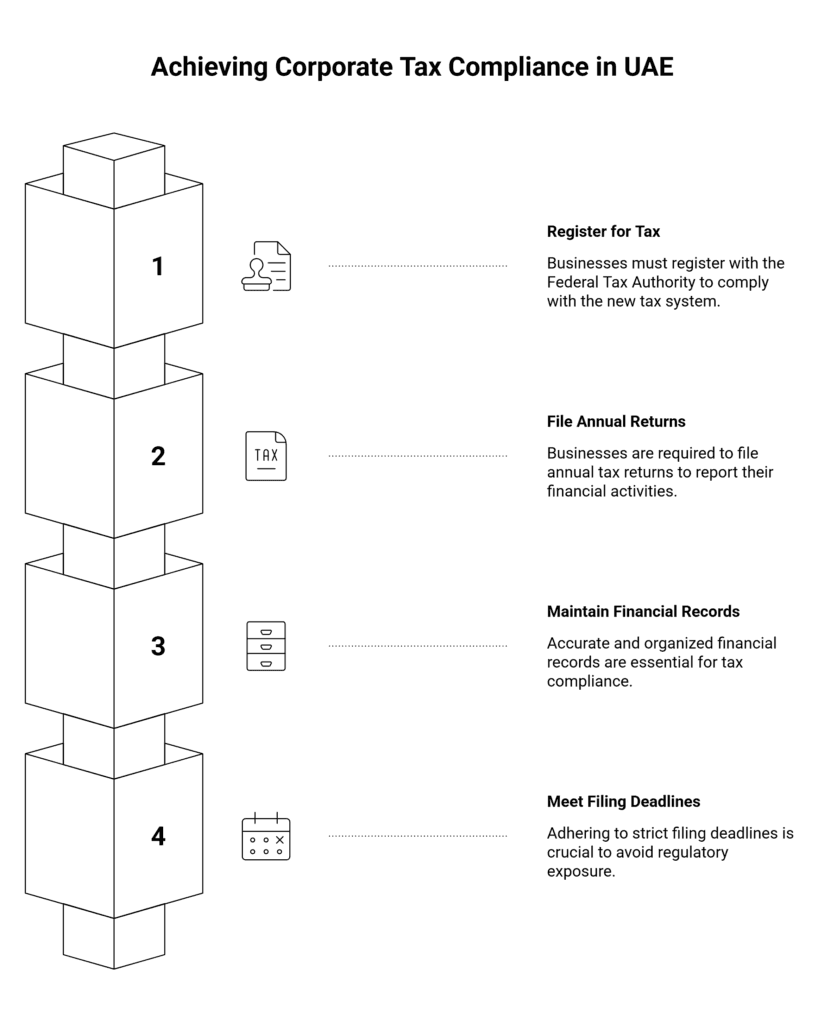
- Businesses must now register for corporate tax
- Annual tax returns are mandatory
- Financial records must be maintained
- Strict filing deadlines must be followed
Missing a deadline isn’t just operational friction — it creates regulatory exposure.
⚡ Quick Answer (Featured Snippet Optimized)
What are UAE corporate tax deadlines in 2026?
- Corporate tax returns must be filed within 9 months after the end of the financial year
- Tax liabilities must be paid within the same deadline
- Deadlines vary based on your financial year-end
👉 This requirement is defined under UAE Corporate Tax Law and enforced by the Federal Tax Authority.
🧠 Why Corporate Tax Compliance Matters in UAE
One-line answer: Corporate tax compliance ensures legal operation and avoids penalties.
Corporate tax compliance is not just about filing — it’s about maintaining financial transparency and regulatory alignment.
Key compliance pillars defined under UAE law:
- Accurate financial reporting
- Transparent accounting practices
- Timely tax filing
- Document retention
👉 Businesses that align early reduce long-term compliance risk and operational disruption.

📅 Official Corporate Tax Deadline Rule (Core Requirement)
One-line answer: All taxable businesses must file and pay corporate tax within 9 months after the financial year ends.
This is the single most important rule in UAE corporate tax compliance.
How it works:
- Your financial year ends → countdown starts
- You have 9 months to:
- Prepare financial statements
- Calculate taxable income
- File tax return
- Pay tax liability
Example:
| Financial Year End | Filing Deadline |
|---|---|
| 31 December | 30 September (next year) |
👉 This structure applies uniformly unless otherwise specified by UAE authorities.
🧾 Corporate Tax Compliance Requirements (Official Framework)
One-line answer: Businesses must maintain records, file returns, and ensure accuracy.
Under UAE Corporate Tax regulations, every taxable entity must:
1. Maintain Accounting Records
- Financial statements must reflect actual business activity
- Records must be structured and organized
2. Prepare Financial Statements
- Based on recognized accounting standards
- Must support tax calculations
3. File Corporate Tax Return
- Submitted through official system (FTA portal)
- Must include accurate financial data
4. Retain Supporting Documents
- Invoices
- Contracts
- Financial records
👉 These documents are essential for compliance verification and audits.

⚠️ Penalties for Non-Compliance
One-line answer: Failure to comply may result in administrative penalties.
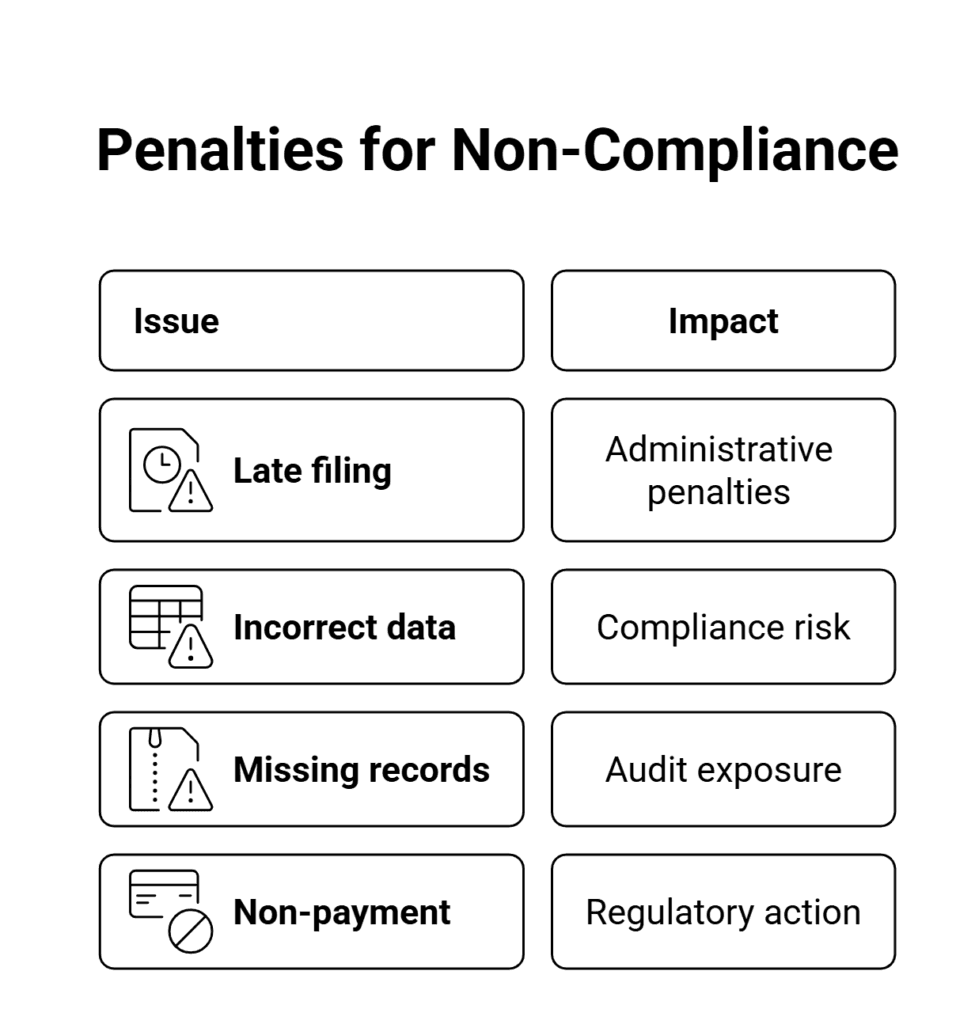
Under UAE law, the Federal Tax Authority may impose penalties for:
- Late filing of tax return
- Failure to pay tax liability
- Incorrect reporting
- Failure to maintain records
Compliance Risk Breakdown:
| Issue | Impact |
|---|---|
| Late filing | Administrative penalties |
| Incorrect data | Compliance risk |
| Missing records | Audit exposure |
| Non-payment | Regulatory action |
👉 Penalties are not optional — they are enforced under UAE tax regulations.
🏢 Who Must Comply with UAE Corporate Tax?
One-line answer: All taxable persons conducting business in the UAE must comply.
This includes:
- Mainland companies
- Free Zone entities (subject to conditions)
- Branches of foreign companies
- Sole establishments (where applicable)
👉 The exact applicability depends on business structure and activity.
🌐 Corporate Tax and Free Zones
One-line answer: Free Zone businesses must still comply with corporate tax rules.
While certain Free Zone entities may qualify for specific tax treatments:
- They must still register for corporate tax
- They must still file tax returns
- They must maintain compliance requirements
👉 Compliance is mandatory even where tax incentives apply.
🏦 Corporate Tax Filing Process (Step-by-Step)
One-line answer: Filing involves registration, preparation, submission, and payment.
Step 1: Register with FTA
- Create tax profile
- Obtain Tax Registration Number (TRN)
Step 2: Maintain Financial Records
- Ongoing bookkeeping
- Accurate documentation
Step 3: Calculate Taxable Income
- Based on accounting income
- Adjusted per UAE tax rules
Step 4: Prepare Tax Return
- Compile financial data
- Ensure accuracy
Step 5: Submit via Official Portal
- File through FTA system
- Confirm submission
Step 6: Pay Tax Liability
- Payment within deadline
- Ensure full settlement
📊 Corporate Tax Timeline (Simplified View)
| Stage | Action |
|---|---|
| Financial Year End | Close books |
| Month 1–6 | Prepare financials |
| Month 6–8 | Finalize tax return |
| Month 9 | File & pay tax |
👉 This structure ensures businesses remain compliant within the legal window.
🔍 Common Corporate Tax Compliance Mistakes
One-line answer: Errors in preparation and timing lead to compliance risks.
Most common issues:
- Delayed bookkeeping
- Incorrect financial reporting
- Missing supporting documents
- Late filing
- Misunderstanding tax obligations
👉 These mistakes are avoidable with proper planning and advisory.
💼 How AdeptBiz Consulting Supports Your Compliance
One-line answer: Expert support ensures accurate, timely, and compliant tax filing.
Corporate tax is technical — and mistakes are costly.
AdeptBiz provides:
- Corporate tax registration
- Financial structuring
- Tax return preparation
- VAT + tax integration
- Ongoing compliance advisory
👉 The goal: zero compliance gaps, full regulatory alignment
📥 Why You Need a Corporate Tax Compliance System
One-line answer: A structured system prevents missed deadlines and errors.
A proper compliance system helps you:
- Track filing deadlines
- Organize financial data
- Maintain documentation
- Prepare for audits
👉 Businesses without systems rely on reactive compliance — which increases risk.
🔗 Internal Resources (For Deeper Support)
To strengthen your compliance ecosystem:
- VAT & Tax Advisory Services
- Accounting & Bookkeeping Services
- Business Setup Services
- UAE Corporate Tax Guide
👉 Integrated services ensure seamless compliance across operations.
❓ FAQ Section (AEO Optimized)
Who regulates corporate tax in UAE?
Corporate tax is governed by the Ministry of Finance UAE and administered by the Federal Tax Authority.
What is the corporate tax deadline in UAE?
Corporate tax must be filed within 9 months after the financial year ends.
Is corporate tax mandatory in UAE?
Yes, businesses meeting the criteria must comply with corporate tax regulations.
Do Free Zone companies need to file corporate tax?
Yes, Free Zone companies must comply with registration and filing requirements.
What happens if a business misses the deadline?
Administrative penalties may apply, and businesses may face regulatory action.
Are accounting records mandatory?
Yes, maintaining accurate financial records is required under UAE law.
Can businesses handle tax compliance internally?
Yes, but professional advisory reduces risk and improves accuracy.
🚀 Final CTA: Stay Compliant, Stay Protected
Corporate tax compliance is not something to figure out last minute — it needs structure, clarity, and execution.
📞 Get Free Tax Compliance Consultation
📞 Call: +971 502213421
💬 WhatsApp: https://wa.me/971502213421
📧 Email: info@adeptbizconsulting.com
🌐 https://adeptbizconsulting.com/







No comment yet, add your voice below!