


Business expansion strategy
Expanding a business in the United Arab Emirates requires more than identifying a new market or opening an additional office. A successful expansion involves financial planning, suitable banking arrangements, licensing approvals, tax compliance, operational readiness and a clear market-entry strategy.
For established businesses, the UAE offers opportunities to expand into new emirates, reach additional customer segments, introduce new services, establish branches and explore international markets.
However, every expansion decision should be supported by a practical business plan that considers the company’s existing structure, financial position, regulatory obligations and long-term objectives.
Whether you are an entrepreneur growing an established company, an SME entering a new market or an international investor expanding into the UAE, understanding these considerations can help you make informed decisions.
In this guide, we explore the key elements of a UAE business expansion strategy in 2026, including corporate banking, financing, Corporate Tax, VAT, licensing, market entry and operational planning.
Table of Contents
- What is a UAE business expansion strategy?
- Why strategic planning matters before expansion
- Choosing the right UAE market-entry approach
- Financial planning and expansion budgeting
- Corporate banking considerations
- Business financing and working capital
- Corporate Tax considerations during expansion
- VAT and accounting considerations
- Licensing and regulatory requirements
- Market entry and operational planning
- A practical 90-day business expansion roadmap
- Common business expansion planning mistakes
- Frequently asked questions
- Conclusion
1. What Is a UAE Business Expansion Strategy?
A UAE business expansion strategy is a structured plan for increasing a company’s commercial presence, revenue opportunities, operational capacity or geographical reach within the UAE or internationally.
It helps business owners determine where to expand, how to finance the expansion, which licenses and approvals may be required and how the new operations will be managed.
A business expansion strategy typically covers six areas:
- Market assessment: Identifying potential customers, demand, competitors and commercial opportunities.
- Business structure: Evaluating whether an existing company, branch, subsidiary, mainland entity or Free Zone arrangement is appropriate.
- Financial planning: Preparing an expansion budget, cash-flow forecast and financing strategy.
- Banking: Reviewing corporate banking facilities, transaction requirements and banking documentation.
- Tax and compliance: Assessing Corporate Tax, VAT, accounting and regulatory obligations.
- Operations: Planning employees, premises, suppliers, technology and business processes.
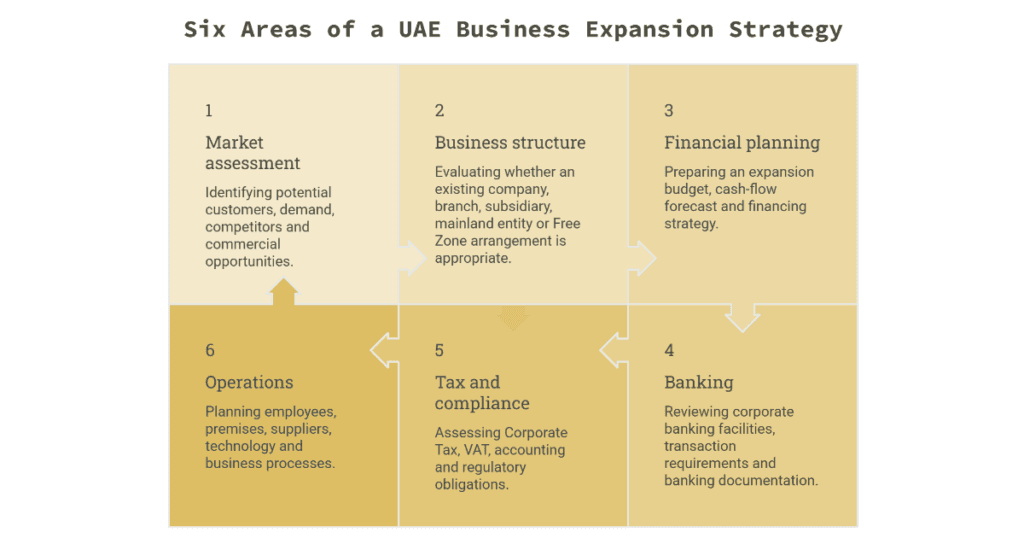
The purpose is to ensure that expansion decisions are commercially realistic and aligned with the company’s long-term objectives.
2. Why Strategic Planning Matters Before Expansion
Business growth can create new revenue opportunities, but expansion also introduces additional responsibilities and financial commitments.
A company may need to increase working capital, hire employees, secure additional premises, obtain regulatory approvals and adapt its accounting and banking arrangements.
Without a coordinated plan, these requirements can become difficult to manage.
Identify the commercial objective
Start by defining why the company wants to expand.
Possible objectives include:
- Reaching new customers in another emirate.
- Introducing additional products or services.
- Establishing a presence in a new industry.
- Increasing trading or service capacity.
- Entering the UAE market from another country.
- Expanding an existing UAE operation internationally.
Each objective may require a different market-entry and licensing approach.
Evaluate business readiness
Before committing resources, review:
- Current revenue and profitability.
- Cash-flow position.
- Existing customer relationships.
- Operational capacity.
- Employee and management capabilities.
- Current licensing structure.
- Outstanding financial and compliance obligations.
A business should understand its existing operational position before deciding how much additional capacity it can support.
Establish measurable objectives
Set realistic targets for:
- New customer acquisition.
- Revenue growth.
- Operating costs.
- Market penetration.
- Customer retention.
- Cash-flow performance.
- Return on expansion investment.
These indicators will help management evaluate whether the expansion is progressing according to plan.
3. Choosing the Right UAE Market-Entry Approach
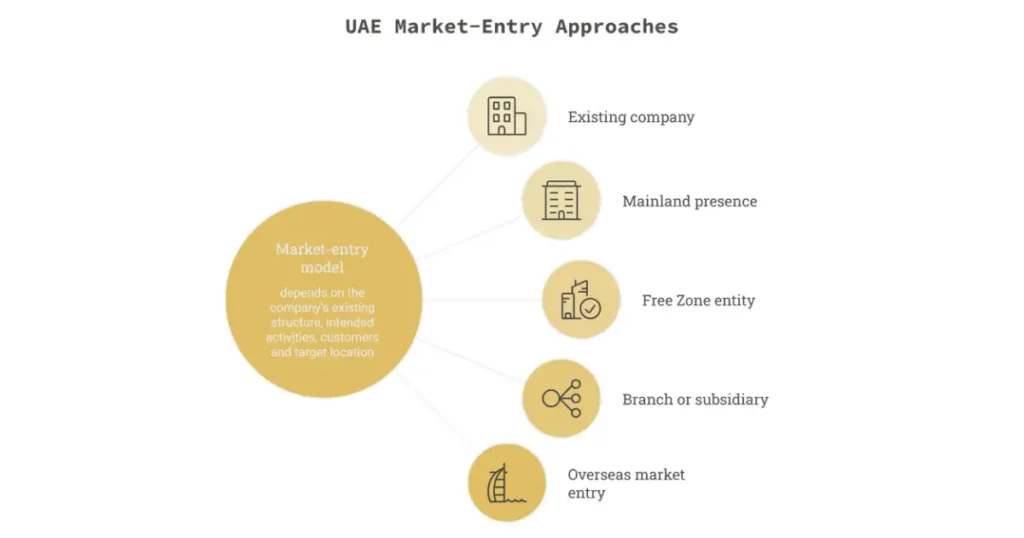
The right market-entry model depends on the company’s existing structure, intended activities, customers and target location.
Businesses may consider several options.
Option 1: Expand through an existing company
Where permitted, a company may expand through its current legal structure by adding approved activities, increasing operational capacity or obtaining the necessary amendments and approvals.
This may be suitable when the existing structure can accommodate the proposed business activity.
Option 2: Establish a mainland presence
A mainland company or branch may be considered when the business wants to access additional UAE commercial opportunities or conduct activities that require mainland authorization.
The relevant economic department and other competent authorities determine the licensing requirements.
Option 3: Establish a Free Zone entity
A Free Zone structure may be suitable for businesses whose activities, operating model and commercial objectives align with the selected Free Zone.
Companies should evaluate the permitted activities, facilities, visa arrangements, customer base and relevant tax conditions.
Option 4: Establish a branch or subsidiary
An existing business may evaluate a branch or subsidiary when expanding into another jurisdiction.
A branch is generally an extension of its parent company, while a subsidiary is separately incorporated. Their legal, financial, governance and compliance implications can differ.
Option 5: Enter the UAE from an overseas market
International businesses planning to enter the UAE should assess:
- Suitable business activities.
- Mainland and Free Zone options.
- Local licensing requirements.
- Ownership and legal structure.
- Banking and financial requirements.
- Tax exposure.
- Premises and employee requirements.
- Local commercial partnerships, where relevant.
The correct approach should be selected after reviewing the business model and applicable regulations.
4. Financial Planning and Expansion Budgeting
Financial planning is one of the most important components of business expansion.
A company should understand both the initial investment required and the ongoing expenses associated with the proposed expansion.
Prepare an expansion budget
Depending on the business model, an expansion budget may include:
| Expense category | Items to evaluate |
|---|---|
| Licensing | Registration, amendments, approvals and renewals |
| Premises | Office, warehouse, commercial space and utilities |
| Employees | Recruitment, salaries, visas and related costs |
| Operations | Equipment, software, technology and supplies |
| Banking | Applicable account fees and financing costs |
| Professional services | Accounting, tax, legal and advisory support |
| Marketing | Advertising, market research and customer acquisition |
| Working capital | Inventory, supplier payments and operating reserves |
Actual costs vary according to the business activity, jurisdiction, facility requirements and operational scale.
Obtain current quotations from the relevant authorities and service providers before finalizing the budget.
Prepare cash-flow forecasts
A company can be profitable on paper and still experience cash-flow pressure during expansion.
Prepare a forecast that considers:
- Expected customer payments.
- Supplier payment schedules.
- Payroll expenses.
- Rent and recurring commitments.
- Inventory requirements.
- Loan repayments.
- Tax obligations.
- Unexpected operating expenses.
Consider different scenarios, such as expected growth, slower customer acquisition and higher operating costs.
Calculate the required investment
Estimate the total capital required to establish and operate the expanded business.
Identify how much can be funded through existing cash reserves, retained earnings, shareholder contributions or external financing.
The funding structure should support sustainable operations without creating unnecessary financial pressure.
5. Corporate Banking Considerations During Expansion
Corporate banking arrangements become increasingly important as businesses increase their transaction volumes, enter new markets or establish additional operations.
A company should review whether its existing banking arrangements support its expansion requirements.
Review existing corporate banking facilities
Consider whether the current banking arrangements are suitable for:
- Increased customer payments.
- Higher supplier transaction volumes.
- International transfers.
- Multiple currencies.
- Payroll transactions.
- Import and export payments.
- Additional operating locations.
- Business financing requirements.
The available facilities and eligibility conditions depend on the bank and the company’s financial and operational profile.
Prepare updated business documentation
Banks may request updated information when reviewing changes to a company’s operations.
Relevant documents can include:
- Valid trade license and corporate documents.
- Shareholder and beneficial ownership details.
- Updated business profile.
- Financial statements.
- Management accounts.
- Business plan.
- Major customer and supplier information.
- Expected transaction volumes.
- Source-of-funds information.
- Supporting commercial contracts and invoices, where relevant.
The exact requirements vary by bank and risk assessment.
Maintain consistent financial records
The company’s license, business activities, transaction descriptions, invoices and accounting records should accurately reflect its operations.
If the business introduces new activities or changes its commercial model, it should review whether its banking profile and supporting documentation need updating.
Practical insight: Banking preparation should form part of the expansion plan rather than being treated as a separate task after the new operation has started.
6. Business Financing and Working Capital
Expansion may require additional funding for equipment, premises, inventory, recruitment, infrastructure or project implementation.
The appropriate financing option depends on the purpose of the funding, the company’s financial position and the available arrangements.
Review potential financing options
Businesses may evaluate:
Internal funding
Using existing cash reserves or retained earnings to finance expansion.
Shareholder investment
Additional capital contributions from existing or new shareholders, subject to the company’s legal and corporate requirements.
Bank financing
Eligible businesses may explore suitable banking facilities based on their financial profile, repayment capacity, collateral requirements and the bank’s credit assessment.
Project financing
Businesses undertaking specific projects may evaluate financing structures linked to project costs, projected cash flows and contractual arrangements.
Trade finance
Importers, exporters and trading businesses may explore trade-related facilities, subject to the bank’s products and eligibility criteria.
Prepare a financing proposal
Before approaching a lender, organize:
- Company background and ownership details.
- Description of the expansion project.
- Purpose and amount of funding requested.
- Historical financial statements.
- Cash-flow forecasts.
- Existing financial commitments.
- Expected project revenue.
- Repayment strategy.
- Supporting contracts or commercial documents, where applicable.
A structured proposal can help lenders understand the business model and evaluate the funding request.
Financing approval remains subject to the lender’s independent assessment.
7. UAE Corporate Tax Considerations During Expansion
Business expansion may change the way a company earns income, conducts transactions or structures its operations.
Corporate Tax implications should therefore be reviewed before implementing a new structure or entering into new commercial arrangements.
Review the company’s Corporate Tax position
The UAE Corporate Tax framework applies to taxable persons under the relevant legislation.
Businesses should review:
- Corporate Tax registration status.
- Taxable income and accounting records.
- Filing and payment obligations.
- Applicable exemptions and reliefs.
- Transactions between related parties.
- Activities conducted through branches or subsidiaries.
- Relevant Free Zone conditions.
The general Corporate Tax rates are:
- 0% on taxable income up to AED 375,000.
- 9% on taxable income exceeding AED 375,000.
The applicable treatment must be assessed under the Corporate Tax Law and its implementing decisions.
Understand Free Zone Corporate Tax conditions
Free Zone businesses should not assume that all income automatically qualifies for the 0% Corporate Tax rate.
A Qualifying Free Zone Person must satisfy the applicable statutory conditions, including requirements relating to qualifying income, substance and compliance.
Non-qualifying income may be subject to the standard Corporate Tax treatment.
Expansion into new activities or markets can affect the analysis, so the company should review the applicable rules before proceeding.
Consider branch and subsidiary structures
A UAE branch of a UAE juridical person is generally an extension of its parent or head office rather than a separate legal person for Corporate Tax purposes.
A separately incorporated subsidiary has its own tax considerations.
The appropriate treatment depends on the structure and relevant transactions.
Review related-party transactions
Where expansion involves transactions between related companies or connected persons, review the applicable transfer pricing requirements.
Maintain appropriate documentation and support the commercial basis of transactions.
8. VAT and Accounting Considerations
Expansion can affect the company’s VAT obligations, invoicing processes and accounting systems.
Monitor VAT registration thresholds
For UAE-resident businesses, mandatory VAT registration generally applies when taxable supplies and imports exceed AED 375,000 over the previous 12 months or are expected to exceed that amount within the next 30 days.
Voluntary registration may be available when taxable supplies, imports or eligible taxable expenses exceed AED 187,500, subject to the applicable conditions.
Different rules can apply to non-resident businesses.
Review VAT treatment of new activities
A company introducing new services, trading activities or cross-border transactions should assess the relevant VAT treatment.
Consider:
- Whether the new supplies are taxable, zero-rated or exempt.
- The place of supply.
- Import and export transactions.
- VAT invoicing requirements.
- Input VAT recovery.
- Relevant registration and filing obligations.
Strengthen accounting and bookkeeping
An expanding business should maintain accurate financial records to monitor performance and support compliance.
Useful practices include:
- Monthly bookkeeping.
- Regular bank reconciliations.
- Accounts receivable monitoring.
- Supplier payment tracking.
- Expense classification.
- Financial reporting.
- Cash-flow forecasting.
- Budget-versus-actual reviews.
Where a company operates through multiple entities or branches, its accounting arrangements should reflect the relevant legal and reporting requirements.
9. Licensing and Regulatory Requirements
Before starting new operations, verify that the company holds the necessary licenses and approvals for its proposed activities.
Review the existing trade license
Check whether:
- The current license covers the intended activities.
- Additional activities need to be added.
- The proposed location is permitted.
- Premises requirements are satisfied.
- External approvals are required.
- Additional professional or technical qualifications apply.
Confirm the relevant authority
Depending on the location and activity, the licensing authority may be a mainland economic department, Free Zone authority or another competent government regulator.
For regulated industries, separate approvals may be necessary.
Examples include healthcare, education, financial services and certain industrial or technical activities.
Keep licensing and banking information aligned
A company should ensure that its actual operations are consistent with its licensed activities and the information provided to relevant institutions.
Any significant business changes should be reviewed for their implications for licensing, banking, contracts and compliance.
10. Market Entry and Operational Planning
A commercially sound expansion plan should consider the market and the company’s ability to deliver its products or services.
Conduct market research
Research:
- Customer requirements.
- Competitor offerings.
- Pricing expectations.
- Industry demand.
- Target locations.
- Distribution channels.
- Potential business partners.
- Customer acquisition costs.
Use reliable market information and validate commercial assumptions before making major investments.
Develop a customer acquisition strategy
Decide how the company will reach its target customers.
Possible channels include:
- Business-to-business sales.
- Strategic partnerships.
- Digital marketing.
- Industry events.
- Professional networks.
- Distribution arrangements.
- Direct sales teams.
Set measurable acquisition targets and monitor the cost of generating new business.
Plan employees and operational resources
Evaluate the additional people, facilities, technology and processes required.
Consider:
- Recruitment requirements.
- Employee visas and work authorization.
- Office or warehouse capacity.
- Supplier agreements.
- Customer support.
- IT infrastructure.
- Operational risk management.
Establish management controls
As operations grow, responsibilities should be clearly assigned.
Develop reporting processes for sales, expenses, financial performance, compliance and operational efficiency.
This helps management identify issues early and make informed decisions.
11. A Practical 90-Day Business Expansion Roadmap
A phased approach can help management coordinate the main workstreams.
Days 1–30: Assessment and strategy
- Define expansion objectives.
- Review the current company structure.
- Research the target market.
- Evaluate competitors and customer demand.
- Identify licensing and regulatory requirements.
- Prepare an initial expansion budget.
- Assess banking and financing requirements.
- Review tax and accounting implications.
Expected outcome: A documented expansion strategy and initial feasibility assessment.
Days 31–60: Preparation and approvals
- Finalize the preferred expansion structure.
- Confirm licensing requirements with the relevant authority.
- Prepare corporate documentation.
- Review premises and staffing needs.
- Update financial projections.
- Prepare banking documentation.
- Evaluate suitable financing arrangements.
- Organize accounting and compliance processes.
Expected outcome: A structured implementation plan with key documentation and responsibilities identified.
Days 61–90: Implementation and monitoring
- Complete applicable licensing and registration procedures.
- Implement approved operational arrangements.
- Coordinate banking requirements.
- Finalize supplier and customer arrangements.
- Prepare internal reporting systems.
- Monitor initial expenditure.
- Track customer acquisition and operational performance.
- Review compliance responsibilities.
Expected outcome: A structured launch or implementation phase, subject to the relevant approvals and operational readiness.
The 90-day timeline is a planning framework, not a guarantee that regulatory approvals, banking decisions or commercial launch activities will be completed within that period.
12. Common Business Expansion Planning Mistakes
Choosing a structure before defining the objective
A license or company structure should support the intended business activity. Start with the commercial objective, then evaluate the available options.
Underestimating working capital
Expansion involves recurring costs, not just initial registration and setup expenses. Prepare cash-flow projections and adequate funding arrangements.
Treating banking as an afterthought
Review transaction requirements, documentation and financing needs during the planning stage.
Overlooking tax and accounting changes
New activities, entities and transactions may create additional tax and recordkeeping considerations.
Entering a market without validating demand
Research the target customer base, pricing, competitors and distribution channels before making significant commitments.
Failing to establish performance indicators
Define measurable targets so management can review the financial and commercial performance of the expansion.
13. Frequently Asked Questions
1. What is the best way to expand a business in the UAE?
The best approach depends on the company’s current structure, target customers, business activities, financial resources and intended market. Options may include adding activities, establishing a branch, creating a subsidiary or entering another jurisdiction through an approved structure.
2. What should a UAE business expansion plan include?
A comprehensive plan should include market research, expansion objectives, legal structure, licensing requirements, financial projections, banking arrangements, financing, tax considerations, staffing and operational planning.
3. Does business expansion require a new trade license?
Not necessarily. Depending on the proposed activity and jurisdiction, an existing license may be amended or a separate license, branch or entity may be required. Confirm the requirements with the relevant authority.
4. Can a UAE company use its existing corporate bank account after expansion?
This depends on the company’s banking arrangements and the nature of the expansion. The business should review whether changes to its activities, ownership, locations or expected transactions require updated information or additional banking arrangements.
5. Does expanding a business affect UAE Corporate Tax?
It can. New activities, related-party transactions, branch operations and additional legal entities may affect tax reporting and compliance. The applicable treatment should be reviewed under UAE Corporate Tax legislation.
6. What financing options can businesses explore for expansion?
Depending on eligibility, businesses may evaluate internal funding, shareholder contributions, bank financing, project financing and trade finance.
7. How can an SME prepare financially for expansion?
An SME should prepare an expansion budget, cash-flow forecast, funding plan and financial performance indicators. It should also review its existing financial commitments and expected operating expenses.
8. Why is professional business advisory useful during expansion?
Business advisory support can help coordinate market-entry planning, licensing, financial preparation, banking requirements, accounting and tax considerations. This allows management to evaluate decisions within a structured business plan.
Conclusion: Build a Structured Strategy for Sustainable Business Growth
Expanding a UAE business is an important strategic decision. It requires a coordinated approach to market research, licensing, banking, financing, taxation, accounting and operational management.
Businesses that evaluate these areas before committing resources can make more informed decisions and develop a clearer roadmap for growth.
Whether you are expanding an established UAE company, entering a new emirate, introducing additional services or planning an international market entry, a structured expansion strategy can help align commercial opportunities with operational and financial readiness.
AdeptBiz Consulting supports businesses with UAE company formation, licensing, corporate banking assistance, accounting, bookkeeping, VAT and Corporate Tax compliance, business advisory and financing-related support.
If your company is planning its next stage of growth, explore the services available through AdeptBiz Consulting and consider developing an expansion plan aligned with your business objectives.
Disclaimer: This article provides general business information and is not a substitute for legal, financial, tax or regulatory advice. Licensing, tax and banking requirements depend on individual circumstances and may change. Verify applicable requirements with the relevant UAE authority or qualified professional before making decisions.






No comment yet, add your voice below!