


Starting a company in the UAE involves more than obtaining a trade license. You need to choose the right business activity, legal structure, jurisdiction, license type, office arrangement, visa strategy, banking setup and tax compliance requirements.
This UAE Business Setup Checklist 2026 provides a practical step-by-step roadmap for entrepreneurs, investors, startups, SMEs and foreign founders planning to establish a company in the UAE.
Whether you are considering a Dubai Mainland company, a Free Zone company or another UAE business structure, use this checklist before you begin your application.
Quick Answer: To start a company in the UAE, generally identify your business activity, choose the legal structure and jurisdiction, select the appropriate license, reserve the trade name, obtain required approvals, prepare documents, arrange the required business premises, obtain the license, complete immigration requirements, open a corporate bank account and meet applicable tax and accounting obligations.
2026 Update: In August 2026, the Ministry of Finance extended Corporate Tax Small Business Relief (0% effective tax for eligible businesses with revenue up to AED 3 million) via Ministerial Decision No. 131 — it now covers tax periods ending on or before 31 December 2029, not 2026 as originally set. Separately, the UAE’s new e-invoicing mandate begins its voluntary pilot on 1 July 2026, with mandatory phases rolling out through 2027 based on company revenue. See Steps 13 and 15 below.
In This Blog
- UAE Business Setup Checklist at a Glance
- Step 1–15: The Full Checklist
- Printable Checklist
- Mainland vs Free Zone Decision Framework
- What Does It Cost?
- How Long Does It Take?
- After You Get Your License
- Common Mistakes to Avoid
- Checklist for Foreign Entrepreneurs
- FAQs
UAE Business Setup Checklist at a Glance
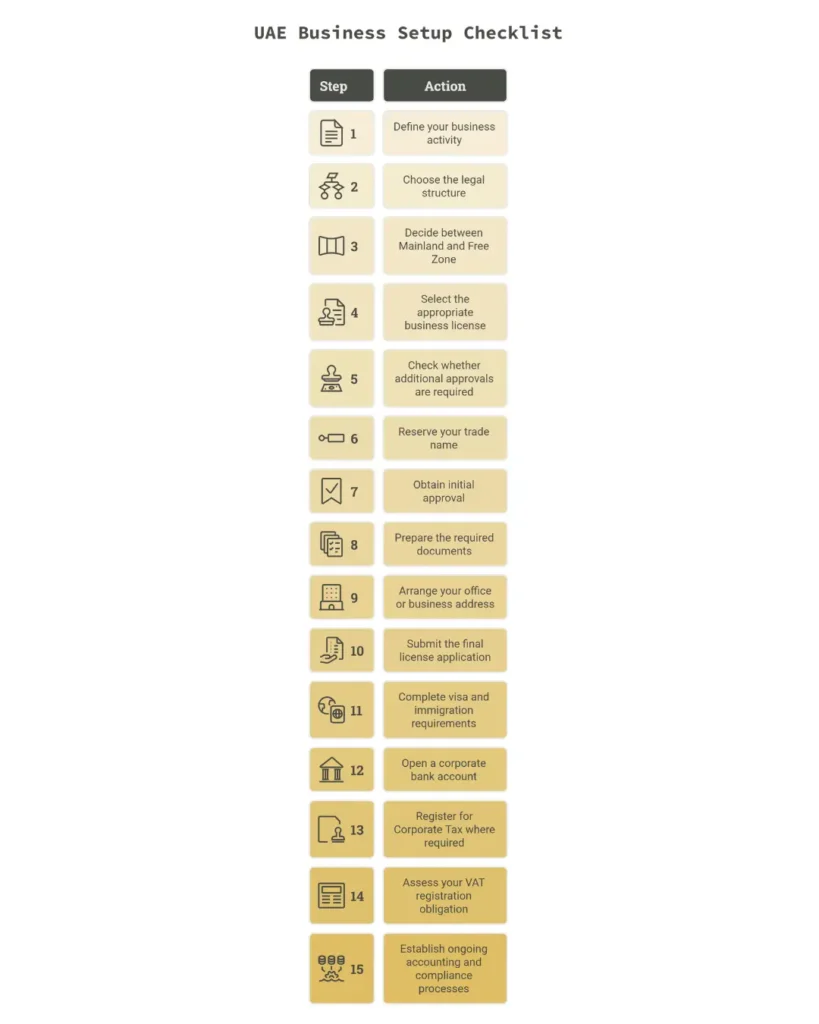
Before starting your company formation process, work through these 15 steps:
Table of Contents
- Define your business activity
- Choose the legal structure
- Decide between Mainland and Free Zone
- Select the appropriate business license
- Check whether additional approvals are required
- Reserve your trade name
- Obtain initial approval
- Prepare the required documents
- Arrange your office or business address
- Submit the final license application
- Complete visa and immigration requirements
- Open a corporate bank account
- Register for Corporate Tax where required
- Assess your VAT registration obligation
- Establish ongoing accounting and compliance processes
The exact requirements can vary according to your activity, Emirate, legal structure and licensing authority.
1. Define Your Business Activity
The first step in a UAE business setup is deciding exactly what your company will do.
Your business activity affects:
- The type of license you need
- The legal structure available to you
- Whether additional government approval is required
- Office requirements
- Certain visa and operational considerations
- Which jurisdiction may be appropriate
The UAE has a wide range of approved economic activities, so entrepreneurs should not simply select a license based on price.
For example, consulting, e-commerce, trading, manufacturing, technology and professional services can have different licensing requirements.
Practical tip
Write down the actual activities your company intends to conduct before selecting a license.
If your business will provide several services, check whether they can be included under one license or whether additional activities or approvals are required.
Related guide: Dubai Business License Types Explained (2026): Complete Guide for Entrepreneurs and Investors
2. Choose the Right Legal Structure
Your next decision is the legal form of your company.
Depending on your business and jurisdiction, possible structures may include:
- Limited Liability Company
- Sole Establishment
- Civil Company
- Branch of a foreign company
- Representative office
- Free Zone company
- Offshore company
The legal structure should match your business activity, ownership requirements, number of shareholders and long-term plans.
Do not choose the legal structure simply because it appears to be the cheapest option.
Why this matters
Your structure can influence:
- Ownership
- Liability
- Licensing
- Banking
- Contracts
- Tax treatment
- Future expansion
For complex structures or foreign shareholders, obtaining professional advice before incorporation can help avoid restructuring later.
3. Choose Between Mainland and Free Zone

One of the most important decisions in the UAE company formation process is choosing your jurisdiction.
The two major options most entrepreneurs compare are:
Mainland
A Mainland company is licensed through the relevant economic department of the Emirate.
Mainland may be appropriate when you need broader access to the UAE market, physical business premises, retail operations, local contracts or certain regulated activities.
Free Zone
Free Zone companies are established through individual Free Zone authorities.
Free Zones can be attractive for entrepreneurs seeking specialized business ecosystems, flexible office arrangements or international-oriented operations.
However, Free Zone rules differ from one authority to another.
Which should you choose?
There is no universally “best” option.
Your decision should consider:
- Business activity
- Target customers
- UAE market requirements
- Office requirements
- Number of visas
- Budget
- Banking requirements
- Tax considerations
- Future expansion
For a detailed comparison, read:
Related guide: UAE Free Zone vs Mainland Company Setup (2026 Guide)
You can also read:
Best Free Zones in UAE for Startups in 2026
4. Select the Appropriate Business License
Your license should correspond with the activities you intend to conduct.
Common license categories include:
- Commercial
- Professional
- Industrial
- Tourism
- Agricultural
- Other activity-specific categories
The exact categories and requirements depend on the relevant authority.
Do not make this mistake
Do not select a license package solely because it has the lowest advertised price.
A low-cost package may not provide the activities, office arrangement, visa allocation or operational flexibility your company actually needs.
Your license should be selected based on your business model first and budget second.
5. Check Whether Additional Approvals Are Required
Some business activities require approval from authorities in addition to the licensing authority.
This may apply to regulated sectors and activities such as:
- Healthcare
- Education
- Financial services
- Food-related activities
- Certain professional services
- Transport
- Real estate
- Media
- Technical and industrial activities
The requirement depends on the exact activity and jurisdiction.
Important
Do not assume that receiving initial approval means you can immediately start operating.
Initial approval and final licensing are separate stages in the business setup process.
6. Reserve Your Trade Name
Once your activity and structure are clear, you can proceed with selecting and reserving a suitable trade name.
Your proposed name must comply with the applicable naming rules of the relevant authority.
Before submitting the name, check:
- Availability
- Naming restrictions
- Similar existing names
- Prohibited terms
- Legal requirements
- Whether the name accurately represents your business
A suitable trade name can also help establish your business identity across your website, contracts and marketing channels.
7. Obtain Initial Approval
Initial approval confirms that the relevant authority has no objection, at that stage, to proceeding with the proposed company formation.
However, initial approval is not the same as a business license.
Depending on the setup, additional documentation, tenancy arrangements, external approvals or legal agreements may still be required before the license can be issued.
This is why entrepreneurs should think of company formation as a sequence rather than a single application.
8. Prepare the Required Documents

Document requirements vary according to the company type, shareholders, activity and authority.
Common documents can include:
- Passport copies
- Emirates ID, where applicable
- Passport photographs, where required
- Proposed company details
- Trade name documentation
- Initial approval documentation
- Memorandum of Association, where applicable
- Local Service Agent agreement, where applicable
- Tenancy documentation, where applicable
- Ultimate Beneficial Owner (UBO) declaration, where applicable
- Additional approval documents for regulated activities
Foreign documents may require additional certification, translation or attestation depending on the circumstances.
A step worth flagging: UBO declarations
Most UAE companies are required to identify and declare their Ultimate Beneficial Owners — the individuals who ultimately own or control the company — as part of the licensing authority’s anti-money-laundering framework. This is separate from your shareholder register and is often requested again later by your bank. Preparing this information early, alongside your other documents, avoids a second round of paperwork.
Best practice
Prepare your documentation before submitting the final application.
Incomplete or inconsistent documents can create unnecessary delays.
9. Arrange Your Office or Business Address
Office requirements depend on the jurisdiction, license type and business activity.
For Mainland businesses, the UAE Government’s business setup guidance includes obtaining a physical address as part of the process.
Free Zones can have different arrangements, including flexible workspace solutions depending on the authority and license.
Your office arrangement can also affect:
- Visa eligibility or allocation
- License requirements
- Operating costs
- Employee capacity
- Regulatory requirements
Therefore, check the office requirement before purchasing a license package.
10. Submit the Final License Application
Once the required approvals, documents and premises arrangements are completed, the final application can be submitted to the relevant authority.
Depending on the setup, the process can include:
- Document submission
- Authority review
- External approval, where required
- Payment of applicable government and licensing fees
- License issuance
Many authorities now process applications through digital government platforms, though eligibility and the exact online workflow depend on your business activity, structure and jurisdiction.
Keep a copy of all submitted documents and issued certificates for your corporate records.
Need help choosing the right setup?
AdeptBiz Consulting provides Business Setup and Company Formation Services in the UAE covering Mainland, Free Zone and Offshore structures.
11. Complete Visa and Immigration Requirements

After company formation, eligible shareholders and employees may need to complete the relevant immigration procedures.
Depending on the circumstances, this can involve:
- Establishment/immigration file procedures
- Entry permit
- Medical examination
- Emirates ID application
- Residence visa procedures
- Employee visa processing
Visa requirements depend on the company structure, authority, quota and individual’s circumstances.
For entrepreneurs who are considering longer-term UAE residency options, additional eligibility criteria may apply, including for the UAE’s long-term (Golden) visa categories.
Related service: Visa and Immigration (PRO) Services & Golden Visa
12. Open a Corporate Bank Account
Obtaining a business license does not automatically mean that a corporate bank account will be approved.
Banks may assess factors such as:
- Business activity
- Company structure
- Shareholder information
- Source of funds
- Expected business activity
- Corporate documents
- Customer and supplier information
- Business model
Prepare a clear explanation of how the company will operate.
Depending on the bank and business, additional documents such as contracts, invoices, business plans or proof of business activity may be requested. Having your UBO declaration and shareholder documentation ready (see Step 8) can help speed this stage up.
Important
Bank account opening should be considered during the company formation stage rather than only after the license has been issued.
A jurisdiction and company structure that works for licensing may not necessarily be the best fit for your banking requirements.
AdeptBiz also provides Corporate Bank Account Opening Facilitation and Business Advisory.
13. Register for UAE Corporate Tax Where Required
Corporate Tax compliance is an important part of your post-incorporation checklist.
Businesses should determine whether they are required to register for Corporate Tax with the Federal Tax Authority and understand their applicable filing obligations.
The headline numbers
Under the UAE Corporate Tax Law, the standard rate is 0% on taxable income up to AED 375,000 and 9% on taxable income above that threshold. Businesses and individuals with annual revenue up to AED 3 million can generally elect Small Business Relief, which treats them as having no taxable income for the relevant tax period. This relief was originally due to expire after 2026, but in August 2026 the Ministry of Finance extended it, via Ministerial Decision No. 131, to tax periods ending on or before 31 December 2029. The AED 3 million revenue threshold is unchanged, and the relief remains unavailable to Qualifying Free Zone Persons or members of large multinational groups.
The extension gives eligible small businesses several more years of simplified Corporate Tax compliance, but it’s still worth confirming your eligibility each tax period — the relief is assessed on an ongoing basis, and revenue exceeding the AED 3 million threshold in any tax period permanently disqualifies the business from claiming it again.
Corporate Tax should not be treated as something to consider only after the company becomes profitable.
Your company should establish appropriate accounting and financial record-keeping processes from the beginning.
For a detailed explanation, read:
Related guide: UAE Corporate Tax Explained for Small Businesses (2026 Guide)
You can also read:
Corporate Tax Deadlines in UAE 2026
For professional assistance:
VAT & Tax Advisory and Compliance Services
14. Assess Your VAT Registration Obligation
VAT is separate from Corporate Tax.
Businesses should determine whether they are required to register for VAT based on the applicable UAE VAT rules.
UAE VAT is a 5% consumption tax applied to most goods and services. The mandatory VAT registration threshold for UAE-resident businesses is AED 375,000 in taxable supplies and imports (measured over the previous 12 months, or expected within the next 30 days), while voluntary registration is available from AED 187,500.
Non-resident businesses making taxable supplies in the UAE must register regardless of value — the threshold does not apply to them.
Therefore, do not simply assume that every newly established company must immediately register for VAT.
Assess your actual business activities, taxable supplies and expected turnover.
For ongoing compliance, businesses should also establish appropriate invoicing, record-keeping and VAT return processes.
15. Establish Ongoing Accounting and Compliance Processes
Company formation is only the beginning.
After receiving your license, you need to manage the company’s ongoing obligations.
Your post-setup checklist should include:
- Accounting records
- Bookkeeping
- Invoices and supporting documents
- Bank reconciliations
- Payroll records
- VAT compliance, where applicable
- Corporate Tax compliance, where applicable
- E-invoicing readiness, where applicable
- License renewal
- Visa renewals
- Corporate documents
- Regulatory filings
- Financial reporting
- Audit requirements, where applicable
New in 2026: e-invoicing
The UAE is introducing a mandatory e-invoicing system, requiring invoices to be issued in a structured electronic format through a government-accredited service provider. A voluntary pilot phase opens on 1 July 2026, with mandatory implementation phased in through 2027 based on annual revenue — larger businesses first, smaller businesses following roughly six months later, and government entities last. Even if your mandatory date is a year or more away, it’s worth confirming your invoicing and accounting software’s compatibility now rather than closer to the deadline.
Good compliance systems should be established from the first month of operation rather than immediately before a deadline.
AdeptBiz provides Audit, Accounting and Bookkeeping Services to help businesses manage ongoing financial and reporting requirements.
UAE Business Setup Checklist: Printable Version
Use this checklist before launching your company:
Business Planning
☐ Define business activity
☐ Identify target customers
☐ Determine required operational scope
☐ Estimate startup and operating budget
Company Structure
☐ Select legal structure
☐ Compare Mainland and Free Zone options
☐ Select appropriate licensing authority
☐ Confirm ownership requirements
Licensing
☐ Select business license
☐ Check additional approvals
☐ Reserve trade name
☐ Obtain initial approval
☐ Prepare legal documents
☐ Arrange required office/business address
☐ Submit final license application
☐ Receive business license
Immigration
☐ Establish immigration requirements
☐ Apply for investor/partner visa where applicable
☐ Process employee visas where required
☐ Complete Emirates ID procedures
Banking
☐ Select suitable corporate bank
☐ Prepare KYC documents
☐ Prepare business model/business plan
☐ Submit bank application
☐ Activate corporate account
Tax & Compliance
☐ Assess Corporate Tax registration
☐ Confirm whether Small Business Relief applies (now available through periods ending on or before 31 Dec 2029)
☐ Assess VAT registration
☐ Confirm your e-invoicing implementation date and provider
☐ Set up accounting system
☐ Maintain financial records
☐ Monitor tax filing deadlines
☐ Monitor license renewal date
☐ Maintain corporate documents
Mainland vs Free Zone: A Simple Decision Framework
If you are still unsure which structure to choose, start with your business model.
| Your Requirement | Potentially Suitable Direction |
|---|---|
| UAE local market operations | Mainland may be suitable |
| Retail/storefront business | Mainland may be suitable |
| Certain government-related contracts | Mainland may be suitable |
| International-focused business | Free Zone may be suitable |
| Lean consultancy | Certain Free Zones may be suitable |
| Technology startup | Depends on activity and requirements |
| Trading business | Compare Mainland and relevant Free Zones |
| Manufacturing | Compare industrial jurisdictions |
| Multiple employees | Compare visa and office capacity |
| Cost-sensitive startup | Compare total first-year cost, not just license price |
This is only a starting framework. Your actual activity and operational requirements should determine the final structure.
For the detailed comparison, see:
UAE Free Zone vs Mainland Company Setup (2026 Guide)
What Does It Cost to Set Up a Business in the UAE?
There is no single UAE business setup cost that applies to every company.
Your total cost can depend on:
- Business activity
- Emirate
- Mainland or Free Zone
- Legal structure
- License type
- Office requirement
- Number of visas
- Immigration costs
- Government approvals
- Corporate documentation
- Banking requirements
- Accounting and tax compliance
This is why comparing companies purely by advertised license price can be misleading.
Before selecting a package, calculate the total first-year cost of operating the business, not simply the initial license fee.
How Long Does UAE Company Formation Take?
There is no universal company formation timeline.
Some straightforward setups can be completed relatively quickly, while others take longer because of:
- Regulated activities
- External approvals
- Document issues
- Office requirements
- Immigration procedures
- Authority processing
- Banking requirements
The UAE Government also provides digital business establishment routes for eligible businesses, but availability and eligibility depend on the business and circumstances.
Therefore, avoid choosing a setup solely because someone promises a fixed number of days.
What Should You Do Immediately After Receiving Your License?
Receiving your trade license is not the end of the setup process.
Your next steps may include:
1. Complete immigration procedures
If visas are required, begin the relevant immigration process.
2. Open your corporate bank account
Prepare your corporate documents and business information, including your UBO declaration.
3. Set up accounting
Establish bookkeeping, invoicing and financial reporting processes — and confirm whether e-invoicing will apply to you and by when.
4. Review tax obligations
Assess Corporate Tax and VAT registration requirements, and confirm whether Small Business Relief applies to you and remains in place for your tax period.
5. Organize compliance
Create a calendar for:
- License renewal
- Visa renewal
- Tax filings
- VAT returns
- Corporate Tax filing
- E-invoicing implementation deadline
- Accounting deadlines
- Other regulatory requirements
A strong compliance system helps prevent last-minute problems.
Common UAE Business Setup Mistakes to Avoid
1. Choosing the cheapest license without checking the activity
The cheapest package may not support your actual business model.
2. Choosing Mainland or Free Zone based only on price
Jurisdiction should be selected according to your customers, operations and growth plans.
3. Ignoring banking requirements
Company formation and bank account approval are separate processes.
4. Forgetting additional approvals
Some activities require regulatory approval beyond the basic license.
5. Treating tax as a future problem
Tax and accounting obligations should be considered from the beginning, including developments such as the Small Business Relief extension and the incoming e-invoicing mandate.
6. Assuming every Free Zone works the same way
Each Free Zone has its own authority, rules, packages and requirements.
7. Failing to plan for year-two costs
Do not budget only for incorporation.
Consider:
- Renewal
- Office
- Visa
- Accounting
- Tax compliance
- Audit, where applicable
- Employee costs
- Banking
- Operational expenses
UAE Business Setup Checklist for Foreign Entrepreneurs
Foreign investors should consider the following before starting:
☐ Confirm whether the chosen activity is available to foreign investors
☐ Compare Mainland and Free Zone options
☐ Check ownership requirements
☐ Confirm documentation requirements
☐ Understand visa options
☐ Assess banking requirements
☐ Review tax obligations
☐ Consider future expansion
☐ Confirm office requirements
☐ Prepare a realistic first-year budget
If you are a foreign entrepreneur planning to establish a business specifically in Dubai, our detailed guide may also help:
How to Start a Business in Dubai as a Foreigner (2026 Guide)
When Should You Get Professional Business Setup Advice?
Professional advice can be particularly useful when:
- You are unsure about Mainland vs Free Zone
- Your activity is regulated
- You have multiple shareholders
- You are a foreign investor
- You need several business activities
- You require visas for employees
- Banking is an important consideration
- You expect international transactions
- You need tax and accounting support
- You plan to expand later
The objective should not simply be to obtain a license.
The objective is to create a company structure that supports your operations, compliance, banking and future growth.
Frequently Asked Questions About UAE Business Setup
What is the first step in setting up a business in the UAE?
The first step is generally to identify the business activity you intend to conduct. The activity helps determine the appropriate license, legal structure and regulatory requirements.
Is Mainland or Free Zone better in the UAE?
Neither is universally better. The right choice depends on your business activity, customers, operating model, office needs, visa requirements, banking considerations and expansion plans.
Can foreigners start a company in the UAE?
Yes. Foreign investors can establish businesses in the UAE under applicable Mainland and Free Zone frameworks, subject to the requirements of the chosen activity and jurisdiction.
Do I need an office to start a UAE company?
Office requirements depend on the jurisdiction, business activity and license type. Mainland and Free Zone requirements can differ, so confirm the specific requirement before incorporating.
What is the UAE Corporate Tax rate?
The standard rate is 0% on taxable income up to AED 375,000 and 9% on taxable income above that. Many small businesses with revenue up to AED 3 million can currently elect Small Business Relief, which the Ministry of Finance extended in August 2026 to cover tax periods ending on or before 31 December 2029. Businesses should confirm their specific registration and filing obligations with the Federal Tax Authority.
Do all UAE companies need to register for Corporate Tax?
Businesses should determine their Corporate Tax registration obligations based on the applicable UAE Corporate Tax rules and their status as a taxable person.
What is the UAE VAT rate and when do I need to register?
The standard UAE VAT rate is 5%. Registration is mandatory once taxable supplies and imports exceed AED 375,000 (over the previous 12 months or expected within the next 30 days), with voluntary registration available from AED 187,500. Non-resident businesses must register regardless of this threshold. Businesses should assess their registration obligation rather than assuming that every newly incorporated company must register immediately.
What is the new UAE e-invoicing mandate?
The UAE is rolling out a mandatory e-invoicing system requiring invoices to be issued electronically through an accredited service provider. A voluntary pilot begins 1 July 2026, with mandatory implementation phased in through 2027 depending on the business’s annual revenue. Businesses should confirm which phase applies to them and check their accounting software’s compatibility in advance.
Can I open a corporate bank account after receiving my license?
You can apply for a corporate bank account after incorporation, but approval is a separate process. Banks conduct their own due diligence and may request additional business, shareholder.
How long does it take to start a company in the UAE?
The timeline varies according to the activity, jurisdiction, documentation, approvals and authority. There is no single timeline that applies to every company.
What documents are required for UAE company formation?
Common documents include passport copies, company information, trade name documentation, incorporation documents. Exact requirements vary by structure, authority and activity.
What should I do after receiving my UAE business license?
After licensing, review immigration requirements, apply for visas where needed, open a corporate bank account, establish accounting systems, and assess Corporate Tax, VAT and e-invoicing obligations.
Final UAE Business Setup Checklist
Before considering your company setup complete, make sure you have reviewed:
☑ Business activity
☑ Legal structure
☑ Mainland vs Free Zone
☑ License type
☑ Additional approvals
☑ Trade name
☑ Initial approval
☑ Required documents
☑ Office requirements
☑ Business license
☑ Visa requirements
☑ Corporate bank account
☑ Corporate Tax obligations
☑ VAT obligations
☑ Accounting and ongoing compliance
A successful UAE company formation is not simply about getting a license quickly.
It is about choosing the right structure before you commit.
Need Help With UAE Business Setup?
AdeptBiz Consulting assists entrepreneurs, investors, startups and businesses with company formation and related business services across the UAE.
Our services include:
- Mainland company formation
- Free Zone company formation
- Offshore company formation
- Business activity and structure guidance
- Visa and PRO services
- Corporate bank account facilitation
- Accounting and bookkeeping
- VAT and Corporate Tax advisory
- Business advisory and compliance support
If you are planning your UAE company formation, you can learn more about our Business Setup and Company Formation Services in the UAE.
For ongoing tax compliance, see our VAT & Tax Advisory and Compliance Services.
Important Disclaimer
This article is intended for general informational purposes only and should not be considered legal, tax, financial or regulatory advice.
UAE licensing, tax, immigration and regulatory requirements can change and may differ according to the Emirate, business activity, legal structure and licensing authority. Figures and thresholds referenced in this article (including Corporate Tax, VAT and e-invoicing dates) reflect rules in effect as of the last update date below and are subject to change by the relevant UAE authorities.
Always verify the current requirements with the relevant UAE authority before making a business or compliance decision.
Last Updated: September 2026 (reflects the August 2026 Small Business Relief extension under Ministerial Decision No. 131)







1 Comment
[…] Here’s the mistake almost every first-time founder makes: they Google “cheapest Free Zone UAE,” pick the lowest number on the page, and find out six months later that their license doesn’t quite cover what they’re actually doing, their bank won’t open an account, or their “0% tax” isn’t as automatic as the ad implied. Check more our UAE Business Setup Checklist […]