


How to Expand a UAE Business in 2026
Expanding a business in the UAE can create opportunities to reach new customers, enter additional markets, introduce new services and strengthen an established operation. However, the right expansion route depends on your existing company structure, business activities, target customers and regulatory requirements.
For an established UAE business, expansion may involve adding licensed activities, opening a branch, establishing a mainland or Free Zone entity, or obtaining the relevant approvals to operate in another jurisdiction.
The key is to choose an expansion structure that supports your business objectives while keeping licensing, tax, banking and compliance requirements aligned.
In this guide, we explain the main UAE business expansion options in 2026, the factors to evaluate before expanding and how to develop a practical expansion plan.
Table of Contents
- What does business expansion mean in the UAE?
- When should a UAE business consider expansion?
- Mainland vs Free Zone expansion
- Opening a branch in the UAE
- Adding business activities or changing a license
- Can a Free Zone company operate on the mainland?
- Key factors to consider before expanding
- Tax, accounting and compliance considerations
- A step-by-step UAE business expansion checklist
- Frequently asked questions
- Conclusion
1. What Does Business Expansion Mean in the UAE?

Business expansion means increasing a company’s commercial reach, operating capacity or range of services. Depending on the business model, this may involve expanding within the existing jurisdiction or establishing an additional licensed presence.
Common expansion routes include:
- Adding new business activities to an existing license, subject to approval.
- Opening a branch of an existing UAE company.
- Establishing a mainland company to serve a broader UAE customer base.
- Setting up an additional Free Zone entity for a specific business purpose.
- Obtaining an applicable permit to conduct certain activities outside a Free Zone.
- Expanding into another emirate or an overseas market.
- Increasing operational capacity through additional premises, employees or facilities.
These options are not interchangeable. A branch, a new subsidiary and an amendment to an existing license can have different legal, financial and administrative implications.
Before selecting a route, determine exactly what the business intends to expand: its activities, geographical reach, customer base, workforce or corporate structure.
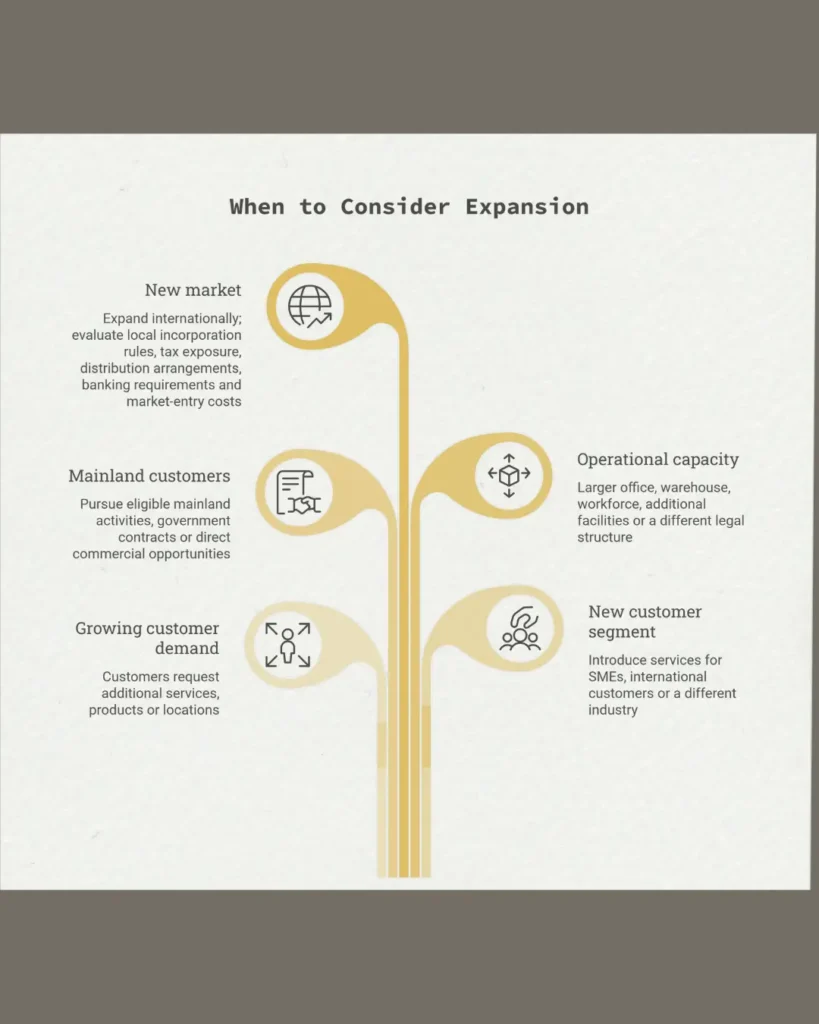
2. When Should a UAE Business Consider Expansion?
Expansion should be linked to a clear commercial objective rather than simply the availability of a new license.
Growing demand from existing customers
A company may consider expansion when customers request additional services, products or locations. For example, a consultancy serving clients in one emirate may want to establish a presence in another market.
Entering a new customer segment
A business serving corporate clients may want to introduce services for SMEs, international customers or a different industry. The proposed activities should be checked against the company’s existing license and any additional approvals required.
Reaching mainland customers
A Free Zone business may wish to pursue eligible mainland activities, government contracts or direct commercial opportunities. The appropriate licensing or permit route must be confirmed for the relevant emirate and activity.
Increasing operational capacity
Growing transaction volumes may require a larger office, warehouse, workforce, additional facilities or a different legal structure.
Entering a new market
Businesses planning to expand internationally should evaluate local incorporation rules, tax exposure, distribution arrangements, banking requirements and market-entry costs.
Practical tip: Before committing to expansion, document the commercial objective, expected demand, operational requirements and total projected cost. This provides a clearer basis for choosing the right structure.
3. Mainland vs Free Zone Expansion

Mainland and Free Zone structures serve different business needs. The most appropriate option depends on where the company intends to operate, the activities it will conduct and the applicable licensing rules.
Mainland expansion
A mainland structure may be worth evaluating when a business wants to serve customers across the UAE, open additional operating locations or conduct activities requiring a mainland license.
Potential considerations include:
- The specific activities permitted under the license.
- Office or premises requirements.
- External approvals for regulated activities.
- Staffing and immigration requirements.
- Applicable fees and ongoing renewal obligations.
- Corporate Tax, VAT and accounting responsibilities.
Mainland businesses should confirm the exact legal form and licensing requirements with the competent authority before proceeding.
Free Zone expansion
Free Zones provide business environments governed by their respective authorities and regulations. They may be suitable for international trade, technology, professional services, logistics and other permitted activities.
A business considering a Free Zone expansion should evaluate:
- Whether the proposed activities are available in the chosen zone.
- The company’s intended customer base.
- Facility and visa requirements.
- The relevant authority’s rules for branches or additional entities.
- Applicable tax requirements.
- Whether additional permissions are required for activities outside the Free Zone.
Free Zone status does not automatically remove all mainland licensing obligations or guarantee a particular Corporate Tax outcome.
How should you choose?
| Consideration | Mainland option | Free Zone option |
|---|---|---|
| Primary objective | Mainland market access and eligible local activities | Activities suited to the chosen Free Zone |
| Licensing authority | Relevant mainland authority | Relevant Free Zone authority |
| Business activities | Must be licensed and approved | Must be permitted by the zone and applicable rules |
| Expansion structure | Existing license amendment, branch or new entity, as applicable | Additional activities, branch, new entity or eligible permit |
| Tax and compliance | Assess the applicable UAE rules | Assess the applicable UAE rules and any Free Zone-specific conditions |
The final decision should reflect the actual business model rather than a general assumption that one structure is always better.
For a broader comparison, see the relevant AdeptBiz guide on Mainland vs Free Zone business setup.
4. Opening a Branch in the UAE
A branch can provide an additional operating presence while remaining legally connected to its parent company. The available route depends on whether the parent is a UAE company, a foreign company or a Free Zone establishment.
A branch is not automatically a separate legal entity independent of its parent.
When might a branch be suitable?
A branch may be worth considering when a company wants to:
- Extend its existing business into another location.
- Maintain continuity with its parent company’s operations.
- Serve customers in an additional jurisdiction.
- Establish an operating presence without creating an entirely separate subsidiary.
The parent company’s legal structure, license, activities and the requirements of the receiving authority will determine whether this option is available.
Documents and approvals
Depending on the jurisdiction and application, authorities may request documents such as:
- A valid parent-company trade license.
- Constitutional documents, such as the Memorandum of Association.
- A board or shareholder resolution approving the branch.
- Details and identification documents for the appointed manager.
- A registered address or premises documentation.
- External regulatory approvals, where required.
- Certified, notarized or attested documents, where applicable.
These are examples, not a universal checklist. The exact requirements must be confirmed with the competent licensing authority.
Branch vs subsidiary
A subsidiary is generally a separately incorporated company, while a branch forms part of the parent company. Their legal, accounting, contractual and risk implications can differ.
Professional advice can help determine whether a branch or a separate company is more appropriate for the intended expansion.
5. Adding Business Activities or Changing a License
Not every expansion requires a new company. In some cases, amending an existing license may be an option.
For example, a company may want to introduce an additional consulting service, expand its trading activities or add a permitted service line.
Before making changes, check:
- Whether the new activity is available under the existing licensing authority.
- Whether the current legal form can conduct the activity.
- Whether additional approvals are required.
- Whether premises, equipment or professional qualifications are necessary.
- Whether the change affects contracts, banking, insurance or tax records.
- Whether the proposed activity changes the company’s regulatory obligations.
An existing license should not be assumed to cover a new activity merely because it is related to the company’s current business.
Where an amendment is not sufficient, a new license, branch, entity or other approved arrangement may be required.
6. Can a Free Zone Company Operate on the Mainland?
This is an important consideration for Free Zone businesses planning to expand their UAE customer base.
The answer depends on the emirate, the activity and the applicable regulatory framework.
Dubai’s Free Zone mainland framework
Dubai Executive Council Resolution No. 11 of 2025 established a framework under which eligible Free Zone establishments may conduct specified activities outside their Free Zones within Dubai, subject to the relevant license or permit and applicable conditions.
The framework provides for routes that can include:
- A license to establish a branch within Dubai.
- A license for a branch operating out of a Free Zone.
- A permit for specified activities, subject to eligibility and requirements.
Depending on the route, prior approval from the relevant Free Zone authority, activity-specific government approvals, a valid license and other documentation may be required. The resolution also addresses separate financial records for certain activities conducted outside the Free Zone.
Do not assume that the framework applies automatically to every company or every activity. Verify the current activity list, eligibility conditions, fees and procedures and the relevant Free Zone authority.
For companies based in other emirates, the applicable local authority’s framework must be checked separately.
7. Key Factors to Consider Before Expanding
Market demand
Identify the target customers, market size, competition and expected sales opportunities. Validate demand before committing to a new office, license or facility.
Total cost of expansion
Prepare a budget covering the costs relevant to your structure, such as:
- License application or amendment fees.
- Registration and establishment expenses.
- Office, warehouse or facility costs.
- Visa and staffing expenses.
- Professional and regulatory approvals.
- Accounting, tax and compliance support.
- Banking and operational costs.
Fees vary by authority, activity and business requirements. Obtain current quotations rather than relying on generic cost estimates.
Legal and operational structure
Determine whether an amendment, branch, subsidiary or new company best fits your objectives. Consider contracts, liability, governance and how the new operation will interact with the existing business.
Banking and working capital
Expansion may increase payroll, inventory, supplier payments and customer-credit requirements. Review cash flow, banking arrangements and financing needs before making commitments.
Staffing and premises
Assess recruitment, immigration, office space, warehousing and any sector-specific facilities or qualifications.
Regulatory approvals
Activities in sectors such as healthcare, education, financial services and other regulated industries may require additional authorization. Confirm requirements before launching the new operation.
8. Tax, Accounting and Compliance Considerations
Expansion can affect a company’s reporting and compliance responsibilities. These should be assessed before implementation, not after operations begin.
UAE Corporate Tax
Evaluate the applicable Corporate Tax treatment of the existing company and any new branch or entity. The outcome depends on the legal structure, taxable status, relevant transactions and applicable legislation.
Free Zone companies should not assume that all income automatically qualifies for a 0% Corporate Tax rate. Qualifying Free Zone Person conditions and other requirements must be evaluated where relevant.
VAT
Review whether the expansion changes VAT registration, taxable supplies, invoicing, recordkeeping or filing obligations. The relevant treatment depends on the transactions and applicable VAT rules.
Accounting and financial records
Maintain appropriate records for the company and any branch or additional operation. Where separate financial records are required under the applicable framework, implement them accordingly.
License renewals and other obligations
Track the renewal requirements of each relevant authority and ensure that the business activities, premises and operating arrangements remain properly authorized.
A structured compliance calendar can help management coordinate renewals, tax filings, accounting and internal reviews.
9. A Step-by-Step UAE Business Expansion Checklist
Step 1: Define the objective.
Identify the new customers, services, location or market the business wants to reach.
Step 2: Review the current structure.
Check the existing license, legal form, permitted activities and jurisdiction.
Step 3: Compare expansion routes.
Evaluate a license amendment, branch, mainland structure, Free Zone arrangement or other applicable option.
Step 4: Confirm the regulatory requirements.
Contact the relevant authority and verify activity eligibility, approvals, documents and current fees.
Step 5: Prepare a financial plan.
Estimate setup and operating expenses, forecast cash flow and identify funding requirements.
Step 6: Assess tax and accounting implications.
Review Corporate Tax, VAT, recordkeeping and related-party arrangements where relevant.
Step 7: Prepare the application.
Organize the required corporate documents, resolutions, premises details and supporting approvals.
Step 8: Implement the expansion.
Proceed with the required approvals and registrations before commencing activities that require authorization.
Step 9: Review performance.
Monitor sales, operating costs, cash flow and compliance after launch.
10. Frequently Asked Questions
1. Can I expand my UAE company without creating a new company?
Possibly. Depending on the activity and jurisdiction, amending an existing license or establishing an approved branch may be sufficient. Confirm the available options with the relevant authority.
2. Should I choose a mainland company or a Free Zone company for expansion?
The answer depends on your customer base, activities, operating model, costs and regulatory requirements. Neither structure is universally suitable for every business.
3. Can a Dubai Free Zone company conduct business on the mainland?
Certain activities may be possible through the relevant license or permit framework, subject to eligibility and applicable conditions. Verify the specific requirements with DET and the relevant Free Zone authority.
4. Is a branch the same as a subsidiary?
No. A branch is generally legally connected to its parent company, whereas a subsidiary is separately incorporated. The implications for liability, governance and accounting differ.
5. Will expanding my business affect Corporate Tax?
It may. The effect depends on the legal structure, activities, transactions and applicable Corporate Tax rules. Review the circumstances before implementing the expansion.
6. What documents are required to open a branch?
Requirements vary by authority and structure. They may include the parent company’s license, constitutional documents, an approval resolution, manager identification and additional approvals or certified documents.
7. How much does it cost to expand a business in the UAE?
There is no single cost applicable to all businesses. Expenses depend on the authority, license type, activities, premises, visas and other requirements. Obtain an itemized quotation based on your proposed structure.
8. When should a business seek professional expansion advice?
Consider professional support when comparing jurisdictions, assessing a branch or subsidiary, reviewing tax implications, coordinating licensing approvals or preparing a budget and compliance plan.
Conclusion
Expanding a UAE business requires more than identifying a new market. The right approach aligns the company’s commercial objectives with its legal structure, licensing permissions, banking arrangements, financial resources and ongoing compliance responsibilities.
Whether you are considering a mainland presence, a Free Zone expansion, a branch or additional licensed activities, assess the options against your actual business requirements before committing to a structure.
AdeptBiz Consulting supports UAE businesses with company formation, licensing, banking, accounting, tax compliance and business advisory services.
Explore the AdeptBiz Consulting website to learn more about the support available for your business expansion plans.
Disclaimer: This article provides general business information, not legal, tax or regulatory advice. Licensing rules, fees and eligibility conditions can change. Verify requirements with the relevant authority before making business decisions.






No comment yet, add your voice below!