


Corporate accounting and bookkeeping UAE
Running a successful business in the UAE involves more than generating sales and managing daily operations. Business owners also need accurate financial records, organized accounting systems and reliable financial reports to understand their company’s performance and meet applicable compliance requirements.
Whether you operate a startup, a small or medium-sized enterprise (SME), a mainland company or a Free Zone establishment, maintaining proper accounting records is an important part of responsible business management.
As a business grows, financial transactions become more complex. Customer invoices, supplier payments, payroll, operating expenses, banking activities, VAT obligations and Corporate Tax requirements all need consistent financial monitoring.
This is where professional corporate accounting and bookkeeping become valuable.
In this guide, we explain how accounting and bookkeeping work in the UAE, what financial records businesses should maintain, how financial reporting supports better decisions and what the applicable record-retention requirements mean for businesses.
Table of Contents
1. What Are Corporate Accounting and Bookkeeping?
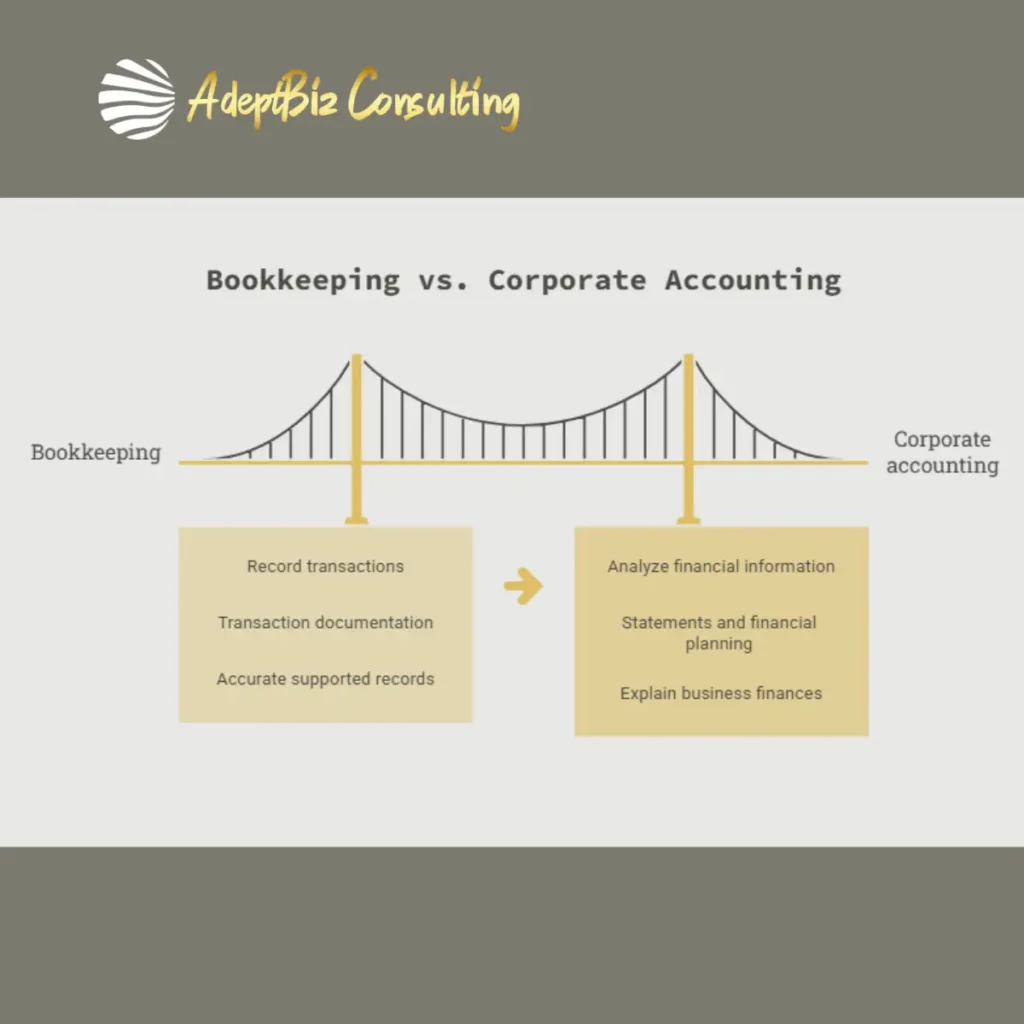
Accounting and bookkeeping are connected financial functions, but they serve different purposes.
What is bookkeeping?
Bookkeeping is the systematic recording and organisation of a company’s financial transactions.
Typical bookkeeping activities include:
- Recording sales and purchase transactions.
- Preparing and recording customer invoices.
- Tracking supplier bills and payments.
- Recording bank transactions.
- Managing petty cash records.
- Maintaining expense documentation.
- Reconciling bank statements.
- Updating accounts receivable and accounts payable records.
The objective is to ensure that business transactions are recorded accurately and supported by appropriate documentation.
What is corporate accounting?
Corporate accounting involves analysing, classifying, summarising and reporting financial information.
It may include:
- Preparing financial statements.
- Reviewing income and expenditure.
- Monitoring profitability.
- Analysing cash flow.
- Preparing management reports.
- Supporting budgeting and financial planning.
- Organising financial information for tax compliance.
- Supporting audit preparation where applicable.
In simple terms, bookkeeping records financial transactions, while accounting helps explain what those transactions mean for the business.
Both functions contribute to financial visibility and informed business decisions.
2. Why Is Proper Bookkeeping Important for UAE Businesses?
Businesses often focus on sales, customer acquisition and expansion. However, without organised financial records, it can become difficult to understand whether the business is performing sustainably.
A structured bookkeeping process provides several practical benefits.
Better financial visibility
Accurate records help business owners understand revenue, expenses, outstanding customer payments and supplier obligations.
This allows management to review financial performance using recorded information rather than relying only on bank balances or informal estimates.
Improved cash flow monitoring
A business may generate strong sales but still experience cash flow pressure when customers delay payments or expenses become due before revenue is collected.
Bookkeeping helps track:
- Outstanding customer invoices.
- Upcoming supplier payments.
- Regular operating expenses.
- Available cash balances.
- Payment collection patterns.
More organised tax preparation
Businesses subject to UAE Corporate Tax and VAT requirements need reliable financial information to support their tax-related processes.
Organised accounting records help businesses identify relevant transactions, review financial information and prepare supporting documents for applicable tax obligations.
Stronger business decision-making
Financial reports can help management identify rising expenses, changes in profitability and areas where resources may need to be adjusted.
This is particularly useful when planning recruitment, investment, expansion or additional business activities.
3. Accounting Records UAE Businesses Should Maintain
The records required depend on the company’s legal structure, business activities, applicable regulations and tax position.
However, businesses should establish a systematic process for maintaining the following records.
Sales and revenue records
Maintain documentation relating to:
- Sales invoices.
- Customer receipts.
- Credit notes.
- Sales agreements, where relevant.
- Revenue from different business activities.
- Customer payment records.
These documents help establish the company’s revenue position and support financial reporting.
Purchase and expense records
Maintain supplier invoices, receipts, purchase orders and supporting documents for business expenses.
Examples include:
- Office rent.
- Employee-related expenses.
- Marketing and advertising.
- Software subscriptions.
- Professional service fees.
- Utilities and telecommunications.
- Travel and business-related expenses.
Expenses should be properly classified, and their accounting and tax treatment should be reviewed according to the applicable rules and the facts of each transaction.
Banking records
Bank statements, payment confirmations, deposit records and financing documents should be retained and reconciled with the company’s accounting records.
Businesses should also establish clear procedures for recording transfers between accounts and distinguishing business transactions from personal transactions.
Payroll and employee records
Businesses with employees should maintain appropriate payroll and employee-related documentation, including salary records and supporting payment information.
Applicable employment and payroll requirements should also be considered.
Asset and liability records
Maintain records of business assets, loans, financing arrangements, outstanding obligations and other relevant balances.
This helps management understand the company’s financial position and track important commitments.
4. UAE Accounting and Record-Keeping Requirements

Businesses operating in the UAE should understand the accounting and record-keeping obligations applicable to their legal form and activities.
Different laws establish different requirements. The following are important provisions for businesses to consider.
Accounting records under the UAE Commercial Companies Law
Records should provide a clear picture of the company’s financial position and enable partners or shareholders to verify that its accounts are properly maintained.
The law requires companies to keep their accounting records at their headquarters for at least five years from the end of the company’s fiscal year.
The law also addresses the maintenance of electronic copies of original documents and papers, subject to applicable requirements.
Corporate Tax record-keeping requirements
Article 56 of Federal Decree-Law No. 47 of 2022 on the Taxation of Corporations and Businesses establishes a specific record-retention requirement.
A taxable person must maintain relevant records and documents for at least seven years following the end of the Tax Period to which they relate.
These records must:
- Support information provided in Corporate Tax returns and other documents submitted to the Federal Tax Authority (FTA).
- Enable the FTA to readily ascertain the taxable person’s taxable income.
Exempt persons must also maintain records necessary to establish their exempt status for at least seven years following the end of the relevant Tax Period.
Examples of supporting records include:
- Business transaction records.
- Sales and purchase invoices.
- Asset purchase and disposal records.
- Liability records.
- Financial statements and supporting schedules.
- Accounting calculations and relevant tax adjustments.
- Other documents supporting information submitted to the FTA.
Tax Procedures record-retention requirements
Cabinet Decision No. 74 of 2023, as amended by Cabinet Decision No. 17 of 2026, sets out general record-keeping periods under the Tax Procedures framework.
The general periods include:
- Taxable persons: Five years following the relevant Tax Period, unless a specific Tax Law provides otherwise.
- Persons other than taxable persons: Five years from the end of the calendar year in which the relevant document was created.
- Real estate records: Seven years from the end of the calendar year in which the relevant document was created under the general Tax Procedures rule.
The Corporate Tax Law has its own specific seven-year requirement. Therefore, Corporate Tax records should not be treated as subject only to the general five-year Tax Procedures period.
The Tax Procedures Executive Regulation also provides for additional retention periods in certain circumstances, including tax disputes, ongoing tax audits, prior notification of an audit, certain voluntary disclosures and pending refund applications.
Businesses should review these provisions before disposing of records.
VAT record-keeping requirements
Article 71 of the VAT Executive Regulation links VAT record-retention requirements to the Tax Procedures Law and its Executive Regulation.
For general VAT records, the applicable period is therefore generally five years for taxable persons, subject to any longer or more specific legal requirement.
A separate rule applies to real estate records. Article 71(2) requires records relating to real estate to be retained for 15 years after the end of the Tax Period to which they relate.
Businesses should distinguish between ordinary VAT records and real estate-related records when setting their document-retention policies.
Record-retention overview
| Record category | Relevant retention period |
|---|---|
| Company accounting records under the Commercial Companies Law | At least 5 years from the end of the fiscal year |
| General Tax Procedures records of taxable persons | Generally 5 years following the relevant Tax Period, unless a specific Tax Law provides otherwise |
| Corporate Tax records | At least 7 years following the end of the relevant Tax Period |
| General VAT records | Generally 5 years following the relevant Tax Period |
| VAT records relating to real estate | 15 years after the end of the relevant Tax Period |
These periods are not interchangeable. The applicable requirement depends on the type of record and the legislation governing it. Additional retention periods may apply in specific circumstances.
5. Maintaining Accounting Records in Electronic Format
Businesses increasingly use accounting software, cloud storage and digital document-management systems to maintain financial records.
Electronic record-keeping can support efficient accounting processes, provided the records meet applicable requirements.
FTA Decision No. 4 of 2026
The Federal Tax Authority issued FTA Decision No. 4 of 2026 on the Rules and Requirements for Maintaining the Information Contained in Accounting Records and Commercial Books.
The decision was issued on 2 June 2026 and became effective on 30 July 2026.
It establishes requirements for maintaining accounting information in electronic-copy or photocopy form.
Under the decision:
- Records and commercial books must be complete and identical to the original documents.
- Records must be clear and easily legible.
- Electronic copies must include all pages in the same order as the original.
- Partial scanning of a document is not accepted.
- The FTA must be able to access the records and the systems in which they are stored upon request.
- Where electronic copies or systems are protected by passwords or encryption, the necessary access information must be provided.
The decision also allows businesses to engage third parties to maintain records and commercial books. However, the business remains legally responsible for maintaining and safeguarding those records.
Practical electronic record-management practices
Businesses should consider:
- Using a reliable accounting and document-management system.
- Scanning complete invoices and supporting documents.
- Maintaining organised digital folders by financial year and document category.
- Restricting access to authorised personnel.
- Maintaining appropriate backup and recovery procedures.
- Ensuring records can be retrieved and produced when requested.
- Reviewing document-retention periods regularly.
A digital accounting system should support the integrity, availability and traceability of financial information throughout the applicable retention period.
Electronic invoicing and record storage
For persons subject to the Electronic Invoicing System, the Ministry states that electronic invoices, electronic credit notes and associated data must be retained for the period prescribed under the Tax Procedures Law and made available to the FTA upon request.
The amendment also removed the previous requirement for this data to be stored within the UAE.
Businesses should review the applicable electronic invoicing implementation requirements and deadlines for their circumstances.
6. Understanding Financial Statements for UAE Companies
Financial statements provide a structured view of a company’s financial performance and position.
Three key financial reports are particularly useful.
A. Profit and Loss Statement
A Profit and Loss Statement, also known as an income statement, summarises revenue, expenses and profit or loss over a particular period.
It helps answer questions such as:
- How much revenue did the company generate?
- Which expenses increased?
- Is the business operating profitably?
- Which activities contribute most to revenue?
- How has performance changed compared with previous periods?
B. Balance Sheet
A balance sheet presents the company’s financial position at a particular date.
It generally includes:
- Assets: what the business owns or controls.
- Liabilities: what the business owes.
- Equity: the residual interest in the business.
It helps business owners understand their financial structure, outstanding obligations and available resources.
C. Cash Flow Statement
A cash flow statement explains the movement of cash into and out of the business.
It generally groups cash flows into:
- Operating activities.
- Investing activities.
- Financing activities.
A company can report accounting profits while still facing cash flow pressure. Monitoring cash flow alongside the Profit and Loss Statement is therefore important.
7. Accounting and UAE Corporate Tax
UAE Corporate Tax makes accurate financial information an important part of business administration.
Businesses subject to Corporate Tax should maintain appropriate accounting records to support their tax calculations, returns and other submissions to the FTA.
General Corporate Tax rates
Under the general Corporate Tax framework:
- 0% applies to taxable income up to and including AED 375,000.
- 9% applies to taxable income exceeding AED 375,000.
Qualifying Free Zone Persons are subject to specific rules, including 0% on qualifying income and 9% on taxable income that does not meet the qualifying income conditions.
The applicable treatment depends on the taxpayer’s status, income and the relevant legal requirements.
Accounting profit and taxable income
A company’s accounting profit and taxable income are not necessarily identical.
Adjustments may be required when calculating taxable income under the Corporate Tax Law.
Businesses should maintain supporting documentation for relevant income, expenses, assets, liabilities and tax adjustments.
Corporate Tax filing and payment deadline
As a general rule, a taxable person must submit the Corporate Tax return and settle the Corporate Tax payable within nine months from the end of the relevant Tax Period.
Businesses should check their actual Tax Period and any applicable FTA requirements rather than relying solely on a calendar-year example.
They should also review whether any applicable exemptions, reliefs or special tax treatments affect their obligations.
8. Accounting and VAT Compliance in the UAE
VAT-registered businesses need reliable accounting records to support their VAT reporting and compliance activities.
Relevant documentation may include:
- Tax invoices issued and received.
- Credit notes.
- Purchase and expense invoices.
- Import and export documentation, where applicable.
- Records of taxable supplies.
- Records of input VAT and output VAT.
- VAT return information.
- Supporting payment documentation.
The standard UAE VAT rate is 5%, although the correct treatment depends on the nature of the supply and applicable VAT legislation.
Businesses should distinguish between standard-rated, zero-rated and exempt supplies.
They should also ensure that input VAT recovery is supported by the applicable legal conditions and documentation.
Accurate bookkeeping helps businesses organise transactions, reconcile VAT accounts and prepare the information needed for VAT returns.
Businesses should retain their VAT records for the applicable statutory period, including the longer retention requirement for records relating to real estate.
9. Common Accounting Challenges Faced by Growing UAE Businesses
As a company expands, its accounting requirements often become more demanding.
Some common challenges include:
Incomplete transaction records
Missing invoices, receipts or payment confirmations can make it difficult to verify financial transactions.
Practical approach: Establish a process for collecting and storing supporting documents as transactions occur.
Delayed bookkeeping
Recording several months of transactions at once can create a large reconciliation workload.
Practical approach: Follow a regular bookkeeping schedule and review records throughout the month.
Unreconciled bank accounts
Differences between bank statements and accounting records can affect the reliability of financial reports.
Practical approach: Reconcile bank accounts regularly and investigate unexplained differences.
Mixing personal and business expenses
Using business accounts for personal spending can complicate financial reporting and transaction classification.
Practical approach: Maintain separate personal and business financial arrangements and document relevant transactions between owners and the company.
Limited financial reporting
Some business owners review their bank balances but do not regularly examine profitability, liabilities or outstanding customer payments.
Practical approach: Prepare regular management reports and use them to review financial performance.
Inadequate digital record management
Poorly organised electronic documents, incomplete scans or inaccessible accounting systems can create difficulties when records are requested.
Practical approach: Use a structured digital filing system and ensure complete, legible records remain accessible throughout the applicable retention period.
10. How Often Should a UAE Business Update Its Accounts?
The appropriate accounting schedule depends on the size of the business, its transaction volume and its reporting requirements.
A practical approach is to use a monthly accounting cycle.
| Frequency | Recommended activity |
|---|---|
| Daily or weekly | Record transactions, collect invoices and monitor payments |
| Monthly | Reconcile bank accounts, review expenses and prepare management reports |
| Quarterly | Review financial performance, cash flow and relevant tax information |
| Annually | Prepare year-end accounts and coordinate applicable audit and tax requirements |
This is a management recommendation, not a universal statutory timetable. Businesses should follow their actual filing, audit and regulatory deadlines.
11. When Should a Business Consider Outsourcing Accounting Services?
Not every business needs a full in-house accounting department.
For startups and SMEs, outsourcing accounting and bookkeeping may provide access to professional support without building an entire internal finance team.
A business may consider outsourced accounting when:
- Financial transactions are becoming more frequent.
- Management reports are not being prepared regularly.
- The company needs support with VAT-related records.
- Corporate Tax preparation requires better-organised financial information.
- Bank reconciliations are frequently delayed.
- Management needs clearer financial reporting.
- The company is preparing for an audit.
- Business expansion is increasing financial complexity.
The appropriate arrangement depends on the company’s size, internal resources and compliance responsibilities.
12. How to Choose an Accounting and Bookkeeping Service Provider in the UAE
Choosing an accounting service provider is an important operational decision.
Before appointing a provider, consider the following factors.
1. UAE regulatory knowledge
The provider should understand the relevant UAE accounting, VAT and Corporate Tax requirements.
2. Industry experience
Experience with businesses operating in your sector can help improve transaction classification and reporting processes.
3. Clear service scope
Confirm whether the engagement covers bookkeeping, bank reconciliation, financial statements, management reporting, VAT support and Corporate Tax-related accounting.
4. Reporting frequency
Understand when reports will be prepared and how management can access financial information.
5. Data security and confidentiality
Financial information is commercially sensitive. Review how records are stored, accessed and protected.
6. Communication and support
A reliable service arrangement should include clear responsibilities, timelines and a process for resolving accounting queries.
13. Practical Accounting Checklist for UAE Business Owners
Use this checklist to review your company’s accounting arrangements.
- Maintain appropriate business banking arrangements.
- Record sales and purchase transactions consistently.
- Keep invoices and supporting expense documents.
- Reconcile bank accounts regularly.
- Monitor outstanding customer invoices.
- Track supplier payments and liabilities.
- Maintain payroll-related documentation.
- Review assets, loans and other obligations.
- Prepare regular financial statements.
- Monitor relevant VAT requirements.
- Maintain Corporate Tax-related financial records.
- Review applicable audit and filing requirements.
- Apply the correct retention period to each record category.
- Maintain complete and legible electronic copies.
- Ensure records can be retrieved when requested.
- Securely store accounting records and supporting documents.
A consistent accounting process helps create a more reliable financial foundation for business operations and growth.
Frequently Asked Questions
1. Is bookkeeping mandatory for UAE companies?
Companies within the scope of the UAE Commercial Companies Law are required to maintain accounting records. Taxable persons may also have additional record-keeping obligations under the applicable tax legislation.
2. How long must a UAE business retain Corporate Tax records?
Taxable persons must generally retain relevant Corporate Tax records and supporting documents for at least seven years following the end of the relevant Tax Period. Exempt persons must also retain records supporting their exempt status for seven years.
3. How long should VAT records be retained in the UAE?
VAT records are generally subject to the applicable Tax Procedures retention period, which is five years for taxable persons. Records relating to real estate must be retained for 15 years after the end of the relevant Tax Period.
4. What is the retention period for company accounting records?
UAE Commercial Companies Law requires companies within its scope to retain accounting records at their headquarters for at least five years from the end of the company’s fiscal year.
5. Can UAE businesses maintain accounting records electronically?
Yes. Electronic copies may be maintained subject to applicable requirements. FTA Decision No. 4 of 2026 requires records to be complete, identical to the originals, clear and accessible. Partial scanning is not accepted.
6. Can a UAE business outsource bookkeeping and record management?
A business may engage a third party to maintain its accounting records and commercial books. However, FTA Decision No. 4 of 2026 confirms that the business remains legally responsible for maintaining and safeguarding those records.
7. What is the general Corporate Tax return deadline in the UAE?
A taxable person must generally file the Corporate Tax return and pay the tax due within nine months from the end of the relevant Tax Period, subject to the applicable law and FTA requirements.
8. What financial reports should a UAE business prepare?
Common financial reports include the Profit and Loss Statement, Balance Sheet and Cash Flow Statement. Management reports may also include outstanding receivables, payables, expense analysis and budget comparisons.
9. Should a UAE business outsource bookkeeping?
Outsourcing may be suitable when a business needs professional accounting support but does not require a full in-house finance department. The service scope should be aligned with the company’s operational and compliance requirements.
Conclusion: Build a Stronger Financial Foundation for Your UAE Business
Accurate accounting and organised bookkeeping are important parts of running and growing a business in the UAE.
They help business owners understand financial performance, monitor cash flow, maintain supporting documentation and prepare for applicable tax and regulatory obligations.
As a company grows, a structured accounting process becomes even more important. Regular financial reporting can support better planning, stronger financial control and more informed business decisions.
Businesses should also review their record-retention policies and electronic document-management systems to ensure they reflect the applicable UAE requirements.
AdeptBiz Consulting supports businesses with accounting, bookkeeping, audit coordination, VAT and Corporate Tax advisory, and broader business advisory services in the UAE.
If your business needs support in organising its financial records or strengthening its accounting processes, connect with AdeptBiz Consulting to discuss your requirements.
Website: https://adeptbizconsulting.com/
Disclaimer
This article is provided by AdeptBiz Consulting for general informational and educational purposes only. It does not constitute legal, tax, financial, accounting or other professional advice and should not be relied upon as a substitute for advice tailored to your specific circumstances. UAE laws, regulations, policies and administrative procedures may change. Readers are encouraged to verify the latest applicable requirements with the relevant UAE authorities and consult appropriately qualified professionals before making business or compliance decisions. While reasonable care is taken to provide accurate and up-to-date information, AdeptBiz Consulting does not warrant that the information is complete or applicable to every individual or business situation.






No comment yet, add your voice below!