


UAE Corporate Tax Registration 2026: What Businesses Need to Know
Corporate Tax registration is now an important part of running a compliant business in the UAE.
For entrepreneurs, companies, Free Zone businesses, branches and certain other taxable persons, understanding whether registration is required, when the application must be submitted and how to complete the process is essential.
The Federal Tax Authority (FTA) requires taxable persons subject to UAE Corporate Tax to register and obtain a Corporate Tax Registration Number. Certain exempt persons may also be required to register if requested by the FTA.
The registration process is completed electronically through EmaraTax, and the FTA currently states that the Corporate Tax registration service is free of charge, with an estimated FTA processing time of up to 20 business days once a completed application has been received.
This guide explains the registration process in practical terms, including who needs to register, important deadlines, documents, common mistakes and what businesses should do after receiving their Corporate Tax registration.
Table of Contents
What Is UAE Corporate Tax Registration?
Corporate Tax registration is the process through which a person or business registers with the Federal Tax Authority for UAE Corporate Tax purposes and obtains a Corporate Tax Registration Number (TRN).
Registration and tax payment are not the same thing.
A business may be required to register even when its final Corporate Tax liability is limited or when specific reliefs or exemptions may apply.
The first question should therefore be:
Is the business a person that is required to register for UAE Corporate Tax?
The answer depends on the legal form, activities, residency status, income or turnover where applicable, and the relevant provisions of the UAE Corporate Tax framework.
Who Must Register for UAE Corporate Tax?

As a general rule, all taxable persons subject to UAE Corporate Tax must register with the FTA. The FTA may also require certain exempt persons to register.
1. UAE Resident Juridical Persons
Companies and other juridical persons established or recognised under UAE legislation can fall within the Corporate Tax regime.
This can include businesses established in:
- Dubai Mainland
- Other UAE Mainland jurisdictions
- UAE Free Zones
- Other UAE jurisdictions where a juridical person is established or recognised
Being established in a Free Zone does not automatically remove the Corporate Tax registration requirement.
A Free Zone business should assess its Corporate Tax position separately, including whether it may qualify for the applicable treatment for a Qualifying Free Zone Person.
2. UAE Businesses Operating Through Branches
The treatment of a branch depends on the relationship between the branch and its parent entity.
The FTA specifically states that a UAE branch of a domestic juridical person is an extension of its parent or head office and is not considered a separate legal entity. Therefore, such a branch is not required to separately register or file for UAE Corporate Tax.
Businesses with domestic and international structures should therefore avoid assuming that every branch requires a separate Corporate Tax registration.
The structure should be reviewed based on the applicable Corporate Tax rules.
3. Natural Persons Conducting Business Activities
Individuals can also fall within the UAE Corporate Tax registration framework when they conduct business or business activities in the UAE.
For a natural person, the relevant threshold is different from the general rule applied to companies.
The FTA states that a natural person conducting business or business activities in the UAE is required to register when their total revenue from those activities exceeds AED 1 million within a calendar year.
Certain income sources are excluded from the calculation, including:
- Salary
- Private investment income
- Real estate investment income
Therefore, an individual should not automatically assume that earning more than AED 1 million from all sources means Corporate Tax registration is required.
The nature and source of the income matter.
Corporate Tax Registration Deadline in 2026

One of the most important points is that there is no single Corporate Tax registration deadline that applies to every business.
The applicable deadline depends on the type of taxable person and the circumstances under which the person became subject to Corporate Tax.
The FTA’s registration framework sets specific timelines for different categories of taxable persons.
For Newly Established UAE Companies
For a UAE resident juridical person incorporated, established or recognised on or after 1 March 2024, the FTA’s published guidance states that the Corporate Tax registration application generally must be submitted within three months from the date of incorporation, establishment or recognition.
Example
Suppose a UAE company is incorporated on:
15 October 2026
Its Corporate Tax registration timeline should be assessed from its incorporation date under the applicable FTA rules.
The business should not wait until it is preparing its first Corporate Tax return before addressing registration.
What About Existing Companies?
For companies that were already established before 1 March 2024, registration deadlines were linked to specific criteria, including the month in which the business license was issued.
Where a juridical person holds multiple licenses, the relevant timeline can depend on the earliest license issuance date under the applicable rules.
This is why businesses should not rely on a generic statement such as:
“My company was incorporated years ago, so I do not need to register yet.”
The correct deadline needs to be determined based on the entity’s circumstances and the applicable FTA timeline.
Corporate Tax Registration for Natural Persons
Natural persons have a different registration trigger.
A resident natural person conducting business or business activities in the UAE is generally required to register when business revenue exceeds AED 1 million during a Gregorian calendar year.
The FTA’s published guidance states that the registration application is due by 31 March of the subsequent Gregorian calendar year when the relevant threshold is exceeded.
Example
If an individual conducting business activities in the UAE exceeds the applicable AED 1 million revenue threshold during 2026, the relevant registration deadline would generally fall in 2027, subject to the applicable rules.
This is different from the registration timeline applicable to a newly incorporated company.
Non-Resident Persons
Non-resident businesses can also have UAE Corporate Tax registration obligations.
The rules depend on the nature of their connection with the UAE, including circumstances involving:
- A Permanent Establishment in the UAE
- A UAE nexus
- Other circumstances specified under the Corporate Tax legislation
The FTA has published different timelines for non-resident juridical persons depending on when and how the relevant UAE connection arose.
For international businesses, this area should be reviewed carefully rather than applying the rules designed for a UAE-incorporated company.
How to Register for UAE Corporate Tax in 2026
The Corporate Tax registration process is completed through the FTA’s EmaraTax platform.
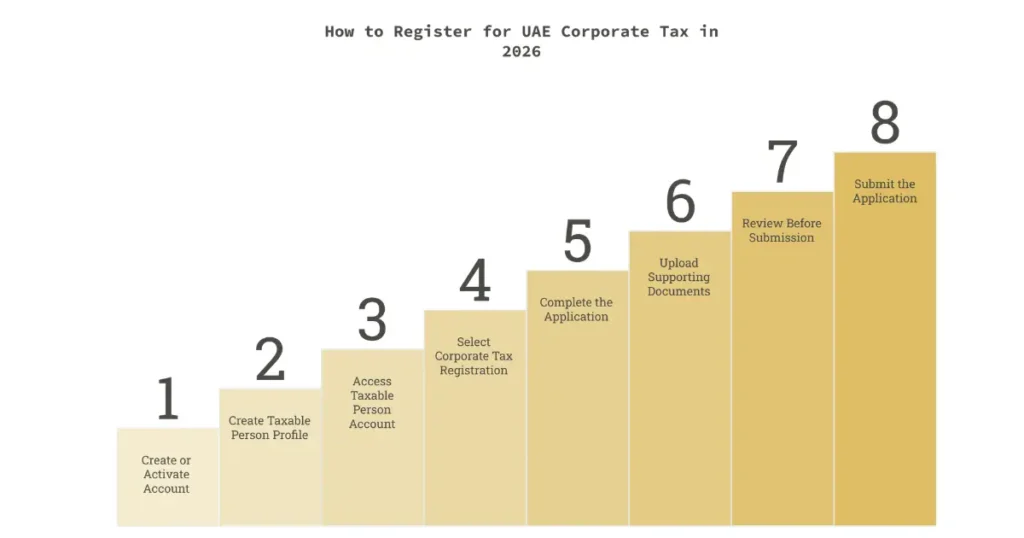
The FTA currently provides the following basic process:
Step 1: Create or Activate Your EmaraTax Account
The first step is to access the EmaraTax platform and create or activate the relevant account.
Step 2: Create a Taxable Person Profile
After accessing the dashboard, create a new Taxable Person Profile where required.
Step 3: Access the Taxable Person Account
Open the relevant Taxable Person Account from the EmaraTax dashboard.
Step 4: Select Corporate Tax Registration
Under the Corporate Tax section, use the available action menu and select the registration option.
Step 5: Complete the Application
Provide the required business, ownership, license and authorised-person information.
Step 6: Upload Supporting Documents
Upload the applicable supporting documents in the required format.
Step 7: Review Before Submission
Before submitting, check:
- Legal name
- Trade license details
- Ownership information
- Authorised signatory details
- Business activity
- Contact information
- Supporting documents
Step 8: Submit the Application
Submit the completed application through EmaraTax for FTA review.
The FTA currently states that its estimated processing time is 20 business days from receipt of a completed application.
Documents Required for Corporate Tax Registration
The exact documentation can vary depending on the taxpayer and structure.
The FTA’s Corporate Tax registration service currently identifies documents that can include:
- Certificate of Incorporation
- Memorandum of Association
- Partnership Agreement, where applicable
- Commercial Registration Certificate or official licensing-authority document
- Valid Trade License, including branch licenses where applicable
- Emirates ID and passport of owners holding more than 25% ownership
- Emirates ID and passport of authorised signatories
- Proof of authorisation for the signatory
Additional documentation may be required in specific circumstances.
Businesses should ensure that documents are current and consistent across their corporate and tax records.
A mismatch between the license, ownership information and submitted application can create avoidable delays.
Is Corporate Tax Registration Free?
Yes.
The FTA’s current Corporate Tax Registration service states that the service is free of charge.
This does not mean that a business will have no other tax compliance costs.
Depending on the business, ongoing compliance may involve:
- Accounting and bookkeeping
- Financial statements
- Tax return preparation
- Tax calculations
- Record keeping
- Tax advisory
- Corporate Tax compliance support
Registration itself, however, is listed by the FTA as a free service.
What Happens After Corporate Tax Registration?
Obtaining a Corporate Tax Registration Number is not the end of the compliance process.
It is the starting point.
A registered business should establish a system for:
1. Maintaining Accounting Records
Financial information should be maintained in a way that supports Corporate Tax compliance.
2. Determining the Tax Period
The business needs to understand its relevant Financial Year and Corporate Tax Tax Period.
For many businesses, this will align with the financial year used for accounting purposes.
3. Preparing the Corporate Tax Return
Taxable persons are generally required to submit their Corporate Tax return within nine months from the end of the relevant Tax Period. The same general deadline applies to payment of Corporate Tax due for that period.
For example, the FTA confirmed that businesses whose Tax Period ended on 31 December 2025 had to file their Corporate Tax returns and pay Corporate Tax due by 30 September 2026.
4. Maintaining Supporting Records
The business should retain relevant records and information supporting its tax position.
This becomes particularly important when determining revenue, taxable income, deductions, relief eligibility and other Corporate Tax positions.
Corporate Tax Registration vs Corporate Tax Payment
This distinction is important.
Registration does not automatically mean that the business owes Corporate Tax on every dirham of revenue.
Corporate Tax liability is determined under the UAE Corporate Tax framework based on the relevant taxable income and applicable rules.
Therefore:
Registration → Tax assessment → Return filing → Payment, where applicable
should be viewed as separate compliance stages.
A business should not use the existence or absence of a Corporate Tax payment as the only basis for deciding whether registration is required.
What Is the Penalty for Late Corporate Tax Registration?
The FTA states that an administrative penalty of AED 10,000 applies for late Corporate Tax registration.
However, businesses should also be aware that the FTA has a Corporate Tax Late Registration Penalty Waiver Initiative.
According to the FTA, the initiative can allow eligible taxable persons to have the AED 10,000 late-registration penalty waived if they meet the applicable conditions, including submitting their first Tax Return within seven months from the end of their first Tax Period.
This should not be treated as an alternative to timely registration.
The most effective compliance strategy is still to determine the registration deadline and complete the application on time.
Common Corporate Tax Registration Mistakes
Mistake 1: Assuming Free Zone Businesses Do Not Need to Register
Free Zone status does not automatically mean there is no Corporate Tax registration requirement.
Businesses should determine their registration and Corporate Tax position separately.
Mistake 2: Confusing VAT Registration With Corporate Tax Registration
VAT and Corporate Tax are separate tax regimes with different registration rules.
A business may have a VAT registration obligation based on VAT rules while Corporate Tax registration is assessed under the Corporate Tax framework.
The two should not be treated as interchangeable.
Mistake 3: Looking Only at Profit
Corporate Tax registration is not simply a question of whether the business currently has a taxable profit.
The registration obligation depends on the applicable Corporate Tax rules and the category of taxpayer.
Mistake 4: Using an Old Deadline
Corporate Tax rules and administrative guidance continue to develop.
Businesses should check the latest FTA requirements instead of relying on an old blog post, social media graphic or previously used deadline.
The FTA’s legislation portal currently lists updated Corporate Tax decisions and guidance, so businesses should use official sources when confirming current obligations.
Mistake 5: Treating Registration as the Final Compliance Step
Getting the Corporate Tax TRN is only one part of the process.
A business should also plan for:
Accounting → Tax Period → Tax Return → Payment → Record Keeping → Ongoing Compliance
This creates a much stronger compliance workflow.
UAE Corporate Tax Registration Checklist for 2026
Before submitting your application, review the following:
Business Information
- Legal business name confirmed
- Trade license available
- Commercial registration information available
- Business activity confirmed
- Incorporation/establishment date confirmed
Ownership & Authorisation
- Ownership information reviewed
- Owners holding more than 25% identified where applicable
- Authorised signatory identified
- Emirates ID/passport documents available
- Proof of authorisation available where required
Tax Compliance
- Corporate Tax registration requirement assessed
- Correct registration deadline identified
- Financial Year confirmed
- Tax Period understood
- Accounting records organised
- Corporate Tax filing timeline planned
EmaraTax
- EmaraTax account created/activated
- Taxable Person Profile created
- Corporate Tax registration selected
- Documents uploaded
- Application reviewed
- Application submitted
- TRN records retained
Frequently Asked Questions
Do all UAE companies need Corporate Tax registration?
All taxable persons subject to UAE Corporate Tax are required to register with the FTA. Certain exempt persons may also be required to register if requested by the FTA.
Do Free Zone companies need Corporate Tax registration?
A Free Zone company should not assume that Free Zone status removes the registration requirement. Taxable persons are required to register, while the applicable Corporate Tax treatment of the Free Zone Person should be assessed separately.
Is Corporate Tax registration free in the UAE?
Yes. The FTA currently lists the Corporate Tax registration service as free of charge.
How long does Corporate Tax registration take?
The FTA currently states that it will take up to 20 business days to review a completed Corporate Tax registration application.
How do I register for Corporate Tax in the UAE?
Corporate Tax registration is completed electronically through the FTA’s EmaraTax platform. The process involves creating or activating an account, creating the Taxable Person Profile, selecting Corporate Tax registration, completing the application, uploading documents and submitting it for review.
What is the penalty for late Corporate Tax registration?
The FTA states that the administrative penalty for late Corporate Tax registration is AED 10,000, subject to applicable rules and any available waiver initiative.
Does Corporate Tax registration mean I automatically have to pay Corporate Tax?
No. Registration and Corporate Tax liability are separate matters. A registered person must comply with the applicable filing requirements, while the amount of Corporate Tax payable depends on the relevant Corporate Tax rules and taxable income.
When is the Corporate Tax return due?
Taxable persons generally have to submit their Corporate Tax return and pay any Corporate Tax due within nine months from the end of the relevant Tax Period.
Final Takeaway
UAE Corporate Tax registration should be treated as part of your business operating framework—not as a last-minute administrative task.
The key steps are straightforward:
1. Determine whether you must register
↓
2. Identify your applicable registration deadline
↓
3. Prepare the required documents
↓
4. Register through EmaraTax
↓
5. Obtain and retain your Corporate Tax Registration Number
↓
6. Prepare for ongoing Corporate Tax compliance
For businesses operating in the UAE in 2026, getting the registration stage right creates a cleaner foundation for tax return filing, accounting and long-term compliance.
Important: Corporate Tax rules can depend on the taxpayer’s legal structure, activities, residency, Financial Year and other circumstances. Businesses should verify their specific position against the latest FTA and Ministry of Finance guidance before acting.
Official UAE Corporate Tax Resources
For the latest requirements, businesses should refer to the Federal Tax Authority and Ministry of Finance.
- Federal Tax Authority — Corporate Tax Registration
- Federal Tax Authority — Corporate Tax Legislation
- Ministry of Finance — Corporate Tax in the UAE
- EmaraTax — FTA’s digital tax services platform
Related AdeptBiz Consulting Resources
For readers who want to understand the wider Corporate Tax journey, this article can internally connect to:
UAE Corporate Tax Explained for Small Businesses (2026 Guide)
https://adeptbizconsulting.com/uae-corporate-tax-explained-small-businesses/
Corporate Tax Deadlines in UAE 2026: Complete Compliance Guide
https://adeptbizconsulting.com/corporate-tax-deadlines-in-uae-2026/
UAE Business Setup Checklist
https://adeptbizconsulting.com/uae-business-setup-checklist/
These links create a logical content journey:
Corporate Tax Basics → Registration → Deadlines & Filing → Ongoing Compliance
Setting up or managing a UAE business involves more than obtaining a license. Corporate Tax registration, accounting, VAT, banking and ongoing compliance should work together as one business framework.
AdeptBiz Consulting can help UAE businesses understand and manage their business setup, accounting, tax and compliance requirements.






No comment yet, add your voice below!